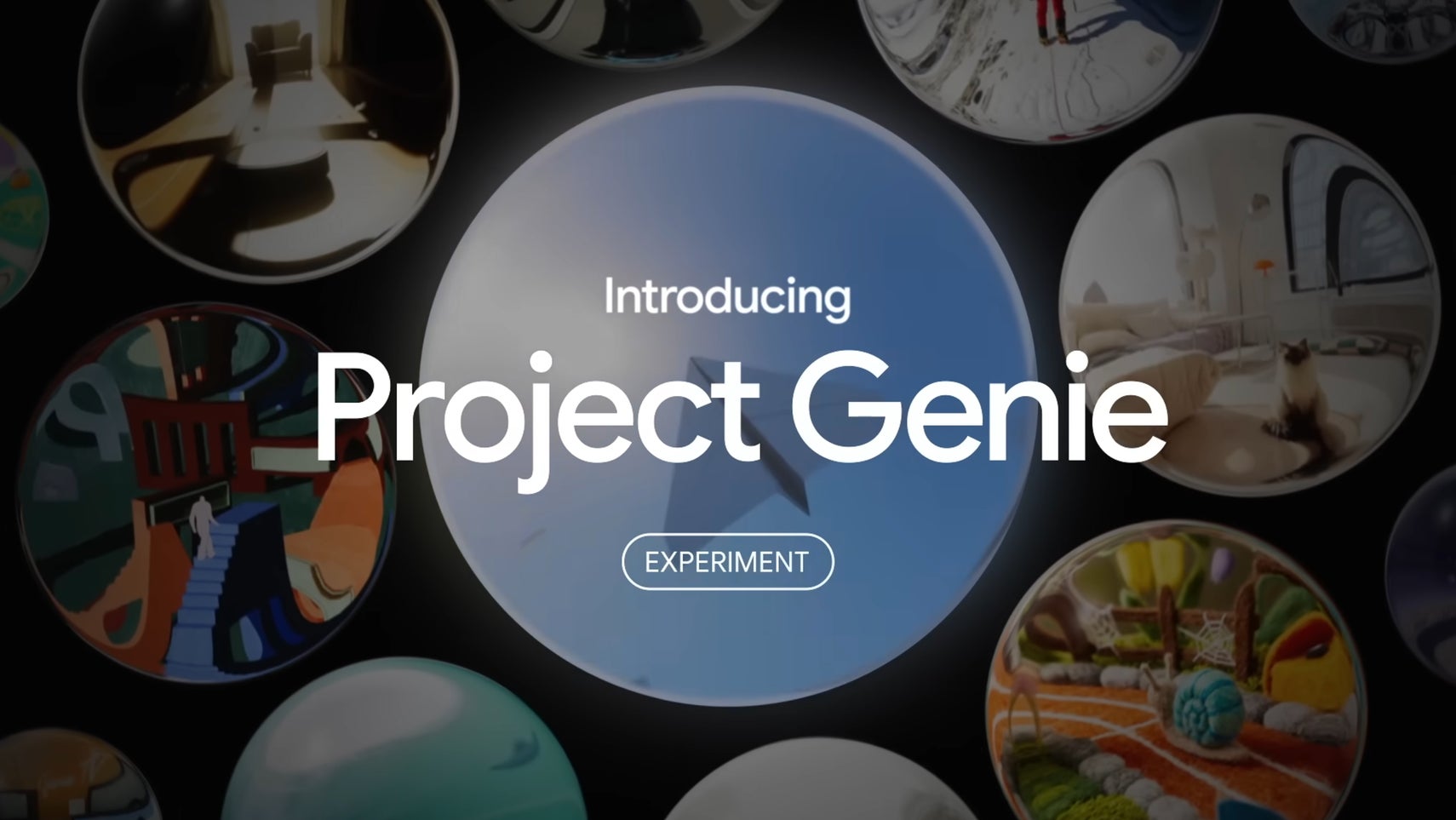
The release of Google's Project Genie has generated a certain amount of attention, almost all of it revolving around the apparent lack of concern expressed by the tech giant for the basic concepts of intellectual property rights and copyright. The news items I've seen so far all focus on how famously defensive IP owners like Nintendo and Disney are likely to react to an app that supposedly lets anyone clone and iterate on their copyrighted properties for the low, low price of $124.99 a month.
According to IGN, some investors are already marking down stocks in other game-making platforms like Unity and Roblox, presumably on the basis that their day is done and in some bright future we'll all be our own game-makers. Or something.
All of which is twaddle, obviously. As all the reports make clear, Project Genie can't make games. It can't even make frameworks for games. Neither can it make virtual worlds.
What it can do is generate a sixty-second interactable snippet, a fuzzy glimpse into a notional, imaginary, three-dimensional environment that has neither persistence nor purpose. It's a curiosity that would probably help a few idle hours pass happily enough, a bit like making paper planes and throwing them out the window or having a tea-party with your stuffed toys.
Personally, I wouldn't pay $124.99 a month for the privilege but if it was on Steam for less than $10 I might give it a go. I imagine it'd be quite amusing to play, with for a while.
Of course, that's ignoring the legal issues. As I said, the first thing everyone seems to have tried to do is replicate their favorite video game, mostly with very limited success.
Even if the results are useless in any practical sense, though, it's hard to imagine the companies currently milking those IPs for every last cent feeling particularly sanguine about letting unlimited, bad versions loose into the community. There's such a thing as tainting the brand, after all.
Let's imagine the famous characters aren't up for grabs. You can't make your version of Mario or Sonic. You have to stick to an original idea of your own. Is anyone but you going to be interested?
One day it may indeed be possible for you or I to type a couple of paragraphs in plain English into an AI app and get a finished game out the other end. I'm close to the end of a book called Supremacy by Parmy Olson on the development of AI and if there's one thing that comes through very clearly it's that the software consistently outruns the expectations of the people behind it. One day you're crowing about some really not very impressive development you've just made and the next thing you know is someone else has jumped ahead a couple of orders of magnitude, leaving your seven-day wonder looking like yesterday's news.
If that does happen with the game-making AI, though, it's unlikely Project Genie will be the name on the box. Everything in AI seems to move forward in a weird, leapfrogging dance. Whoever starts something rarely gets to finish it.
Even if it does become possible to generate fully functional virtual worlds from plain English text prompts, the history of gaming doesn't entirely suggest that would wipe out everything else. Roblox is an outlier. A very, very big outlier, true, but an outlier all the same. There's clearly a sizeable market for making your own video games and selling them to other gamers and Roblox has mostly cornered it.
For as long as I've been gaming, which is getting on for fifty years now, there have always been game-making programs that purported to allow gamers with imagination but little or no technical skill to create and sell their own games and those have always been niche.
In the 1980s I wrote text adventures with a utility called The Quill. Lots of people did, then saved them on cassette and sold them through the back pages of gaming magazines. In the '90s I made a full-length RPG scenario with Neverwinter Nights and uploaded it to one of the dedicated, online repositories along with many thousands of others, where it probably remains to this day.
I've dabbled with many other game-making packages, none of which required anything less than a huge amount of time and effort to create anything recognizably game-like. There have even been programs to make your own MMORPG, none of which seems to have resulted in any MMORPG I ever heard of. And of course there are the semi-pro, cut-down versions of the real thing, like Unity or Unreal, that you can buy into for an almost not unreasonable investment.
If anyone with some minimal degree of skill and a very much larger amount of time and enthusiasm wanted to make a "playable world", they have and have had for a very long time, the means to do so. The appeal of AI is that soon no-one will need any appreciable skill or time to make a really impressive video game. It'd be nice to think you'd still need the enthusiasm but honestly that's probably optional too.
Except I'm not sure all that many people really want to. Imagine for a moment a scenario where Project Genie actually works. Imagine you could type in a brief description of the sort of virtual world you'd like to see, the kind of characters and plot you'd want to engage with and the general gameplay you'd enjoy there. How about...
Setting: A High Renaissance setting in which the industrial revolution happened a couple of hundred years early. Some Steampunk trappings but not too many. The game is set in a small city-state with a coastal border and some mountains, a lot of forest. Low magic, some werewolves and vampires, grudgingly integrated in the cities, not tolerated in country areas.
Plot: The high king is ageing. He has no obvious successor. He wants to leave a legacy so he makes covert moves to back a potential candidate who wishes to improve the status of the non-humans in the state. This is potentially popular with the urban elite but could cause rebellion in the countryside.
Gameplay: RPG mechanics with hierarchical magic and skill development. Dropped gear. Turn-based combat.
Sounds great, doesn't it? Took me less than ten minutes, straight off the top of my head. Imagine if I could drop that into an app, go make a coffee, then come back and download a complete game.
It'd be fun once. Just like writing a game with the Quill and NWN was fun, once. I even enjoyed playing through my own games. Again, just once.
Did I send off for anyone else's self-written Quill games, though? No, I did not. I didn't even download any of the myriad, free NWN adventures. Maybe a couple, just to have a look. But even then I never played them for more than a few minutes.
What about Second Life? All the games people made there? Did those take over the market? Not hardly.
And even the supposedly ubiquitous Roblox hasn't exactly wiped every other game off the screens, has it? Sure, a lot of people, kids mostly, play it but is it all they play and do they mostly play it because it's what they have access to and what they can afford? Like Runequest, famously the first MMORPG of so many people when they didn't have the money or the technology for anything more impressive, are these games really successful because of how good they are or how accessible and available?
It's really hard to be sure. If AI output was demonstrably not slop but really top quality, indistinguishable from very good human-made work and you could generate whatever you wanted on the fly - books, movies, games - would most people move over to it? I'm not sure they would.
I think they'd still need to be marketed to. I think there'd need to be a buzz. People like to watch, read, play things lots of other people are playing, so they can talk about them, argue about them, share the experience. At that point, it might not matter that the product was AI-generated but it would still very much matter that it was high-profile and being talked about, out there in the media.
If it was something no-one but the person watching or playing it would ever hear about, I suspect the potential audience would be somewhat limited. I think there's certainly a demographic that'd be happy to sit at home, alone, playing reading and watching the insides of their heads acted out by imaginary characters but, like VR, I just don't see it becoming normative, mainstream behavior.
In the end, I suspect that even were AI ever to reach the point where it can produce high-quality entertainment with almost no human input, it's still going to be only a certain, very small percentage of that work that gets the attention of a human audience. And it won't be for it's AI qualities but for the human-to-human interactions it facilitates.
In other words, we may all end up playing AI-generated games but we'll still be playing the same ones or else we won't be able to talk about them. And more importantly, no-one will be able to sell them to us.

 Posts
Posts


The entry barrier to make games isn't as high as most peaple seem to think it is. The real entry barrier is having an idea anyone would ever care about. Hell, I'm not even talking money. I am talking spend actual time in it even if you gave it to them for free.
ReplyDeleteI used to play around with a Goldbox RPG design tool. I converted a PnP module, and then made a town for players to work out of becuase the module was just a dungeon. I certainly enjoyed it, but I doubt anyone else would have. I also downloaded some that other peaple made. Even the highest rated and most elaborate ones managed like maybe a few hours of my time.
Experiences I had had with content creation tools embedded in MMOs have been similar. I think the best ones I ever encountered were in CoH, and even those were fairly mid compared to the content made by proffessionals (the game itself).
A comparison I meant to make in the post was with Craft Fairs. Companies and vendors make a great living selling crafting kits and supplies and books to would-be crafters, who use them as best they can, then take the results to local craft fairs, where they sit all day as other would-be crafters wander by and don't buy anything. Very few of them make anything anyone wants. Even fewer make anything that looks even semi-professional.
DeleteMost game-making software in the past has been a bit like that. There's only so much you can do without genuine talent. AI is going to mask that a bit, if it gets better, but in the end if you don't have the ideas, the skill and the determination, it isn't going to end well.
The real question in my mind is what will happen when AI is able to replicate that skill and creativity convincingly. It can't yet but that doesn't mean it never will. My feeling is that the human audience raised on human-generated content will never feel entirely comfortable with AI content, mostly for reasons they won't even be able to articulate accurately. It will continue to feel wrong, somehow. As for generations growing up with AI content as at least part of the norm, though, I wouldn't be at all sure they'd have the same issues.
The lack of creativity in AI will kill it. But, with Neverwinter Online's Foundry, I not only made adventures, I played the heck out of other people's. Because it took a LONG TIME with those tools to make an adventure and the pro developers who used that tool made stories that blew me away. I doubt AI will ever be able to match that.
ReplyDeleteGenie makes a setting, not a game. Real games can't be described in a sentence.
You have to be a prime example of someone who could make exceptional use of AI tools to make games people would enjoy playing. I played a couple of your NWO dungeons and they were great fun. Imagine if there was an AI game-maker that worked as well as the AI coder you were writing about recently on West Karana. You'd absolutely kill it!
DeleteBut that's because you have the ideas *and* you're more than willing to do the work. The AI would just mean you could spend your time more effectively. For most people, I fear, the ideas wouldn't be that great and they wouldn't have much interest in doing the work. AI as a tool wouldn't be much use to them at all. Which is why it's still going to need humans to produce anything really interesting for the foreseeable future, I think.
The problem I see with the whole "make your own X" is that in reality, people don't know what they want, let alone why. We hoomin are kind of good at finding out that we don't like something, but that's a completely different beast from what we do like. Specially when there's a challenge in it, we like it though enough to feel rewarded when we succeed but not a single line tougher than our will to keep trying. And how though is that, raise your hand if you know where the ripping point is, and I'll call you either a liar or a fool.
ReplyDeleteAnd then of course, Genie is AI as we know it and it's as bad as everything else since no AI thinks and imitation only works until everything imitates everything else. Some people start claiming that AI slop might save the internet by giving value to the ability to find, deliver and share good content rather than just engagement... what Google and the internet portals of old did when they delivered curated content...