Showing posts with label culture. Show all posts

Monday, May 11, 2026

Career Opportunities - Work-Life Balance In Neverness To Everness

As Tyler Edwards pointed out in the comments to yesterday's post, there are certain constraints involved in designing a game to be released in China. Or there are if you don't want to fall foul of Fenris Creations - er, sorry, I meant the CCP. Easy mistake!

Until then, it hadn't really occurred to me that Neverness To Everness was a Chinese game. Indeed, it didn't even occur to me then, or not in that exact form. What did occur to me was that I had no idea where the company behind the game I was playing was based other than somewhere in the mysterious East.

I rarely do. Honestly, it might as well be the nineteenth century for all the attention I've been paying to where most of the "imports" I keep picking up and then dropping might be coming from.

This has been going on quite a while now, hasn't it? Forever, really, for as much as that means in the context of online gaming. I remember Mrs Bhagpuss and I playing the beta for some MMORPG from China so long ago I can't even remember what it was called any more. Just that it was one of her favorites for a while.

Whatever it was, I don't believe it ever came out in "the West". I just know it was long before we played Runes of Magic or Zentia although maybe not before I played NeoSteam...

The more I think about it, the more it seems it's always been this way, even if I do have a vague feeling I used to be much clearer on where the games I was playing were made. Final Fantasy XI came from Japan for a start. I always knew that. NeoSteam was Korean. I did have to fact-check that one just then but I was pretty sure. 


Zentia was from China and so was Loong. Or was Loong just set in China? It was published by Gamigo and they're... what are they now? German! I had to look that up even though I see some news item about Gamigo very nearly every day. Loong, it turns out, was developed by DACN out of Shanghai so it was Chinese.

These days, though, I rarely have much of an idea who's behind anything I'm playing, unless it's a company I know already. And sometimes, even when it's one I ought to recognize, I find I don't. 

I'm well aware Neverness To Everness is being developed by Hotta Studios. I've known that from the start. It's an easy-to-remember name. Or you'd think it would be. It can't be that easy to remember, though, because I only just realized this morning, as I was researching this post, that Hotta is the company behind that very successful MMORPG from a few years back, Tower of Fantasy.

At least, I think it was very successful. Wasn't it? For a while I saw a lot of people talking abut it but now I come to think of it, that didn't last long. No-one ever mentions it now. 

I never played it, which seems strange, given I'll play just about anything, so long as it's free and I think I can get a couple of blog posts out of it. As it happens, I know why I didn't play Tower of Fantasy. You won't guess. It's not a rational explanation. Or maybe it's too rational. 

I didn't play Tower of Fantasy because from the moment I saw the name I imagined the entire game was literally in a tower. I thought you'd have to start at the bottom and work your way up and that would be the all you'd ever do, which did not sound like a lot of fun to me, so I passed.  

I'm not completely crazy! There are MMORPGs that have towers like that inside them. It's a popular feature, I believe, although obviously not with me. I thought someone had just decided to make a whole game out of it, the way some developer or other is always trying to make an MMORPG that's all raids or all dungeons, one with no actual world to waste anyone's time.

By the time I'd realized my mistake it was a couple of years too late to jump on the very short-lived ToF bandwagon and so far I've never gotten around to giving it a go. I'm still not saying I won't but I'm guessing that particular bus has left the stop.

Although I feel like I might at least have recognized the name, in one way I'm not surprised I didn't. There doesn't appear to be a great deal of similarity between ToF and NTE. Different setting, different genre, different everything, pretty much. (ToF veterans are welcome to pop into the comments and tell me why that's just so wrong...assuming there's anyone reading who ever played it.)

Less defensible is my complete ignorance of where NTE was made. Is being made. It'd be nice to think country of origin doesn't matter for a video game but that would be a hard case to make. For all the hopes and fears trotted out across the past few decades, all the arguments in favor or against globalization, this is still a world of nation states and nations have cultures all their own.

Only in games, maybe not so much. It's blurry at best. For one thing, publishers with a global reach want to sell to all markets and they don't necessarily want to be running multiple versions to suit local tastes. Even if there is still a surprising amount of that sort of thing going on. 

For another, "globalization", as it applies to entertainment these days, often means "localization". Movies are made with different endings or a different emphasis in the storyline so as to play better in various territories. Games are localized not just by language but by cultural expectations including but not limited to age, dress code and the creatures you have to kill. I have a post brewing about aesthetic fragmentation that might get written one day...


Localization for the "Western" market does, theoretically, make it less obvious what the original intentions of the creators might have been but it's often no more than a thin, surface veneer stretched over a mostly unchanged framework. The innate cultural values and taboos that, consciously or unconsciously, drive the narrative and the aesthetic remain.

Or I assume they do. Except that I have such a shaky understanding of what those values and taboos might be, it's touch and go whether I'd recognize them in the first place. If there's one thing playing more games developed in China has taught me it's that I don't really know what China's like. Modern China, anyway.

Zentia used to be my idea of a "Chinese" game - all pagodas and dragons and people wearing straw hats. Neverness To Everness feels much more like my idea of a Japanese game, all modern technology, skyscrapers and neon. Which, to be fair, would also be my ignorant take on a Korean game, I guess, except I'd expect anything from Japan to be quirkier and cuter...

Is this racist? Maybe. I think it's more likely just ignorant. And lazy. I'd hold my hand up to both of those. 

Does it matter in the context of playing a video game? I guess not, so long as it leads to unconsidered assumptions being challenged and changed. And that does happen, quite a lot.

For example, unrelated to Tyler's comment and how it got me thinking about who was behind NTE and what they were trying to tell me, I'd already been wondering why there was such a huge focus on work in the game. It's a major theme. Possibly the major theme.

All the characters talk about their work all the time. It might be an even bigger obsession with many of them than food. All of them have jobs that they seem to take very seriously but despite their career goals, most of them also seem to have some kind of side-hustle going on. How they find time to sleep, let alone fit in any kind of social or private life, beats the hell out of me.

I'm not even talking about hand-wavy game mechanics, like the way they can all somehow pop up to fight my battles for me any time, anywhere. Or how the same characters can work for me, 24/7,  staffing the ever-increasing number of cafes that make up my growing business empire. No, I'm talking about proper, in-game second jobs the characters hold in character, usually menial, entry-level, gig economy deals like handing out leaflets in the street or doing courier work.

More worrying is the way no-one seems to have any kind of employment rights. The subject of overtime comes up constantly, always with characters dreading it but glumly accepting it as an inevitability of employment. And everyone appears to be on-call all the time. Having an official day off in no way prevents anyone from getting an urgent call telling them to come back to work. 

They all complain about it but none of them questions it. Work comes first seems to be a universally acknowledged maxim. Someone literally says it in one of the quests I did yesterday although I failed to get a screencap. As someone who's spent their entire life doing their best to avoid as much work as possible, I find it exhausting just to watch! I want the characters to kick back against the system that exploits them - organize, unionize, withdraw their labor - anything other than just complaining about it in private but doing it anyway.

I guess that's why my favorite character in the game so far is Hitori, the boss of Eidon Antiques. Hitori seems to do as little work as possible. She sleeps a lot, drinks a lot more, and mostly sends other people to do the jobs she can't be bothered with, which is all of them. As we see in the Main Story sequence, she's extremely capable when she needs to be but she doesn't feel the need to waste any energy proving herself to anyone. Mint, for onecould learn plenty from her example. 

The whole milieu reeks of double standards, hypocrisy and compromise, anyway, and Hitori is management so she can afford to delegate. She's not in any position to set an example. Half her staff is children! 

Granted, it's hard to tell exactly how old anyone's meant to be in NTE, what with the ever-rejuvenating anime art style, but Nanali, Edgar and Sakiri are specifically referred to as "kids" on multiple occasions, not least by Hitori herself. And Eidon isn't an isolated example of child labor. Illica and Haniel from Sterry Express seem to be much the same age, give or take a year or two.

What are the rules in Hetherau about employing children? Aren't they supposed to be in full-time education? There are certainly schools because one of the side quests takes you inside one but I don't see the slightest hint that any of the teenage cast is enrolled anywhere. 

Maybe being an Esper takes you out of the classroom? I could buy that if they were all transferred into some government program for potential assets in the Anomaly Wars but how would it square with them all ending up in the back room of an antique shop owned by an alcoholic, spending their time watching TV, bickering and pretending to run a junior version of the mob? 

But then the ordinary rules don't seem to apply to characters destined to become playable some day. It's different for Hethereau's regular citizenry. They don't get to sit around watching shows all day long.

Still, it is true that most of the people Flora meets seem to be reasonably happy in their work. All those hucksters outside stores and the sales people behind the counter inside. If you talk to them at length, though - and you often can because there's a lot of incidental, non-storyline dialog in NTE - it's often possible to sense an underlying dissatisfaction or ennui; workers for the same company getting a better deal, other branches offering a better quality of life... The grass is always greener ten blocks over.


Perhaps the most overtly subversive conversation I've enjoyed so far was with an unnamed "Slacking Citizen", who gleefully informed Flora that "slacking off is the essence of work". That's the attitude! She was still very concerned Flora not tell her boss, mind you, so i don't think she's going to be doing any organizing anytime soon

Maybe I'm reading more into all of this than I should but I can't help feeling the writers are telling us something about the society they live in. I get the feeling they may not disagree with the ethics of the way work is where they're from but they find the execution just a little hard to manage. Yes, work is great and of course we all need to do our best all the time but wouldn't it be nice to have a goddam day off, once in a while?

I imagine, if you're sufficiently attuned to it, you'd be able to sense specific cultural nuances within all the games that would clue you in to which specific countries the developers - or maybe just the writers - came from, without needing to look up the street address of the company to be sure. It's probably all there, embedded in assumptions about family, responsibility, work and individualism, themes that seem to come up in dialog over and over again.

For an ignorant westerner like me, though, what it mostly does is reinforce a pre-existing idea that life is more regimented in the East, wherever the East might be. And for me, the whole idea of taking what you do for a living in any way seriously seems almost distasteful. That's how I was raised.

I mean, it's only a job, isn't it? It's not like it's anything important...

Friday, July 18, 2025

Blurring The Boundaries


Friday. Traditional day of the Grab Bag. I have a few ideas. Mostly game-related, too. Let's see what's in there...

First up, a couple of news stories about the positive influence of gaming. I know, right? We ought to be past that by now. But are we? 

Video Games Are Bad Good For You 

The new trend seems to be people who are already famous for something, testifying about how gaming in general, or a specific game in particular, helped them to do what they do and/or become who they are, by which, of course, I mean who we know them as. Who they actually are is and will always remain a mystery.

The two celebrities, if I may use that catch-all, are Bella Ramsey and Taylor Fritz. I vaguely knew Bella Ramsey's name but I couldn't have told you where from. Taylor Fritz I'd never heard of, although I bet my 92 year-old mother has. 

In case you're as clueless as me, Ramsey is an actor who's appeared in Game of Thrones and The Last of Us, among other things. Two shows I probably should have watched but haven't and most likely never will. Fritz is a tennis player, good enough to have made the semi-finals at Wimbledon this summer, hence my mother's undoubted knowledge of his existence. In fact, according to the article, he's ranked #5 in the world.

Pirate Penguins. Possibly.
Their gaming-related... I nearly said "confessions" there, which would have been telling, but I guess they're more like affirmations.... their gaming-related stories - let's go with that - involve exploring gender identity in Bella's case and... erm... being about as good at League of Legends as he is at tennis in Taylor's.

Honestly, neither of those revelations should be remotely surprising and they really aren't presented that way, either. We do seem to be past the time when famous people playing video games was, in itself, worthy of comment. At least now it has to be relevant in some way to what we hear about them in other contexts, to provide supporting evidence of their journey in some way.

The interesting parts of both stories for me were the specifics not the generalities. I thought it felt quite significant that Bella Ramsey explored her gender identity while playing Club Penguin. Not so much because she had one that she felt needed exploring but because of the venue she chose for her explorations. 

I'm fairly confident that wasn't what Disney had in mind when they bought the game for $350m in 2007. They also owned Toon Town, another child-focused MMORPG at that time and I'm almost certain I've read another account of someone famous exploring their gender identity there, although I can't remember who that might have been. Please append notes and sources in the comments if you do.

It does make a very good case for the anonymity and fluidity of these games for children and young teens. Free Realms is another one where stories like this come up quite not infrequently. Maybe John "Smed" Smedley should have thought a bit more about the social and cultural benefits before shuttering the much-loved MMORPG, rather than complaining how hard it was to wring money out of kids.

The part of Taylor Fritz's tale that caught my attention wasn't that he was really, really good at LoL. He's a world-class sportsman. You could predict that. No, it was that he made a point of explaining he didn't, as you might imagine, play League of Legends to relax or wind down or get away from the challenges and tensions of international tennis. 

On the contrary, he pointed out that playing LoL at the level he does (Emerald.) is "very mentally taxing and mentally draining" and requires his full attention and engagement. It makes a convincing case for eSports being taken seriously, when one of the world's top sportspeople says playing a video game requires as much from him as his real-world sport. Okay, as much mentally. But still...

I Am, But What Am I?

Following on from Bella Ramsey's gender explorations in Club Penguin, I thought I'd link to one of last year's Blaugust newcomers, Cynni of Cynni's Blog. We had a lot of new bloggers join last year and I put most of them either in my Feedly or on the blog roll but over the months since then I gradually unsubscribed from nearly all of them. I already spend altogether too long every day reading blog posts. It just wasn't feasible to keep up with all of them.

The ones on the blog roll, though, I didn't remove and I still actively keep up with a few, even if I don't read every post. Cynni, in common with a disturbing number of bloggers I follow, seems to have been having a pretty bad time of things lately but she always has a good perspective on life and I found her post on gender identity very informative and thought-provoking. 

I also just finished a very good book by Griffin Hansbury that made me think even more. The book is called Some Strange Music Draws Me In, a lyric from Patti Smith's Dancing Barefoot, and it's a coming-of-age novel about a trans man. Er... boy... er... well, it's complicated, isn't it? Language, I mean. And gender. 

Read the book, that's all I'm saying. I learned some things.

I find myself thinking about this stuff a lot nowadays. Partly that's because it's in the culture in a big way now but mostly it's because I keep wondering what it would have been like to have grown up in a culture where those concepts were more fluid than they were when I was doing it. 

Tenses are complicated, too, aren't they? Yes, I do wonder what it's like for people who are growing up in that social and cultural environment today but mostly I find myself idly transposing the times, imagining how things would have been, had it been that way then, when I was in school and college, not how it would be for me if I was in school or college now. There is a difference.

I am old and I'm not about to change who I've always been or perhaps more accurately who I've always thought I've always been, although the sheer range of descriptive genders I encountered, many for the first time (Well, the first time in print. I'm sure I've met many inhabiters of said genders in life without realizing.) both the post and the book do offer plenty of options, smoe of which do resonate with me, at least to some degree. For now, though, my pronouns remain he/him and I don't foresee making a shift from the gender identity I've always accepted. 

But of course it's a lot more complicated than that. Again. Isn't it always? As I think about it, there have been  so many times I haven't conformed all that closely to the labels I've been wearing, so many behaviors I've exhibited and choices I've made that don't exactly fit the shape those labels describe. It's very apparent that we're not all just one thing even if some of us definitely are.

And it's not like I didn't recognize and talk about it back then, either. What we now call gender identity was a fairly common topic of discussion in some of my social groups in the eighties and nineties. We just didn't have the language to express the shades and nuances that are all up in the culture now. Mostly we used to get drunk and speculate about our friends, who speculated about us, when we weren't around. Pretty sure that's not well-thought of these days.

I wish we had talked more about our own identities rather than trying to figure out other peoples'. I'm not saying it would have led to different choices but it might have. It would almost certainly have affected my understanding of who I was and who I could be. Probably, I would have ended up much the same but I wouldn't claim it as a certainty. 

It would have been better to have had the language to talk about it, anyway. In the end, it's always about the language, isn't it? Everything is.

I have a few more solid discussion topics along these lines stashed away but I'm saving them for Blaugust so instead I'll just slide into a couple of snippets that kinda-sorta relate to things I've mentioned earlier in the post.

Now That's A Weird Name

Reaper Actual, I mean. It is, though, isn't it?  Is it a quote? A reference? A pun? Does it mean something or is just supposed to sound cool? And if so, does it?

Whatever it's doing, it's the latest attempt by the aforementioned John Smed Smedly to get back into the gaming industry. As a player, that is. 

No, wait, that's not helping... I don't mean he wants to play some video games. I'm sure he does that in the evenings and on weekends already. I wonder what his League of Legends rank is?

No, I meant get into it as a player like in the Robert Altman movie, The Player, by which I don't mean to suggest Smed's going to start producing movies or ending up killing anyone... well, not anyone real. He's certainly going to end up killing a lot of virtual people because he's all about the PvP and his new project is... 

... well, I'm not sure what it is, other than it's called Reaper Actual, which not only tells you nothing but doesn't even really suggest anything, other than perhaps some kind of homicidal accountant. No, hang on... I'm thinking of an actuary there, aren't I?

MassivelyOP, the only place I've seen it reported so far, don't seem to know what sort of game it is, either. They stop short of labeling it an extraction shooter, merely noting it has "extraction shooter gameplay".  They aren't really all that interested in speculating about what other sort of gameplay it might have because they're far too busy boiling the tar and plucking the chickens. 

Reaper Actual is going to be on the blockchain. Wave the red flags. I must say I thought we were over the blockhain now. And Web 3.0. And Crypto (Although not Krypto. We're definitely all over Krypto, not over him. See? Language again...) I thought AI had eaten all of their lunches and now we were consolidating all our techno-fears in one, handy package.

Anyway, I'd say I'll be interested to see what Smed comes up with this time but I'd just be lying. I'm not interested in anything he does except out of habit. Blockchain or not, I won't be playing it. I just wish he'd retire, really, although as I'm finding out, that's not aways the choice you make, even when it's an option.

And finally...

Google Blinks, Meta Casts Shade

Ye gods, that's a convoluted sub-heading. Let me unpack it. 

Remember Google Glass? It was a long time ago, wasn't it? Just as a quick refresh, it was a project Google was big on for five minutes that involved a pair of glasses with built-in video cameras and internet connectivity. 

It got the same treatment every other new tech gets these days, namely scorn, derision, fear and hatred and Google limply caved to popular pressure (Or internet bullying, to give it its other name.) almost immediately, dropping plans to develop it for the mass market in 2015 and pretending it had never happened. 

They didn't actually stop development, though. They re-marketed it as a specialist product and it was quietly adopted for certain market sectors. There were still versions available commercially as recently as two years ago, although the project is now officially and finally dead.

Since then, other companies have produced similar devices and no-one seems to have noticed or cared. Privacy doesn't seem to be quite the buzzword it was back in the twenty-teens, does it? And now Mark Zuckerberg is getting in on the act. 

I found out about this in a very odd way. My mother is officially registered as partially-sighted, meaning gets information sent to her from various sources, telling her about services and prodcts that may be helpful. She got a flyer in the mail from one of the government-sponsored organizations that handles visual impairment, inviting her to go to the local library for a hands-on with some new glasses you could get that would read things like bus timetable or bottle labels out loud for you when you looked at them.

We've had stuff about these things before but they usually run to several thousand pounds a pair and you can't just walk in and try them on anywhere, so it seemed like a good opportunity to see if they'd justify that kind of investment. 

My mother went to the library, gave them a go, didn't think she'd get on with them, and that would have been the end of it, except she brought back the leaflet she's been given and it had the actual name of the device, which hadn't been on the original flyer, so I googled it. Ironically, as it turned out. 

The Meta Wayfarer Sunglasses are made, as the name suggests, by Meta in co-operation with RayBan, (Hence "shade" in the sub-heading. I know. Painful, isn't it?). The concept looks a lot like Google Glass to me. 

It has a built-in video camera and uses AI for instant translation, among other things. You can livestream from your glasses to Facebook and Instagram. It uses your smartphone for the internet connectivity but apart from that it seems to do everything everyone said would mean the end of civilization if Google Glass caught on. It's also about a tenth of the price I was expecting so I imagine take-up could be high. 

Of course, they have the advantage of looking exactly like RayBans, which means instead of throwing rocks at you in the street if they see you wearing them, they're more likely to be calling out "Cool shades, bro!". By comparison, Google Glass made you look about as obvious as if you'd hung a sign around your neck saying "Caution: Filming In Progress". 

Ten years too early and wearing the wrong clothes. Poor old Google, eh? Probably should get out of the lab more. Still, maybe it's time Zuckerberg caught a break. That VR thing didn't go so well, did it? 

And that's all I have today although not all I have. More when there's a free slot.

Final thought... just imagine how much better this post would have looked if I'd used AI illustrations. Didn't even think of it until I was about to hit publish. That tells a story all its own... 

Tuesday, March 28, 2023

Nothing Gold Can Stay


I read an interesting article at Slate.com last week, the premise of which was that the much-hyped but largely real Golden Age of TV that began at some nebulous point around the turn of the millennium, probably about the time the first episode of The Sopranos (A show I still haven't watched.) aired on HBO, hasn't just peaked or even ended, as has been argued, but has turned into a full-on slide from peak to trough.

When the fulcrum shifted from the networks to subscription services and then to streaming, it very much felt like a tide that would not easily turn. The level of quality expected by viewers rose so substantively it seemed hard to imagine anyone settling for less. 

In many ways that remains a sustainable argument. Certainly, production values and the quality of both script and performance haven't slipped noticeably from the high-water mark of ten or fifteen years ago. All the big-budget shows still benchmark at or above the comparable standard in cinema, a target that would have seemed laughably unattainable in TVs previous "Golden Age", let alone in the regular programming of the wilderness decades of the sixties thru the nineties.

As has been discussed many times in this corner of the blogosphere (We really need to figure out a better way to describe our nebulous collective. If there's one thing spheres definitively do not have, it's corners...) the increasing tendency of all the streaming platforms to commission shows they then decline to renew, often for reasons that remain opaque, is starting to look like an existential crisis for the format. Viewers are making decisions on what to start watching based on their assessment of how likely they are to be able to find resolution when the show concludes, creating a negative feedback loop that only increases the likelihood the shows won't get renewed.


Perhaps more damagingly, there's increasing evidence of a concerning tendency of streaming platforms to straight up abandon shows altogether, not just in terms of forward continuity but even in retaining episodes already made for viewing. Along with the rise of streaming, digital distribution and the worldwide web, came an easy expectation that everything would be available forever. Physical media rapidly fell out of fashion and there was much talk of future generations owning nothing but their devices and a handful of contracts and subscriptions to that great media library in the cloud.

I should probably say here that I was one of those people who believed a decade and more ago that we were on the cusp of a true digital revolution. I thought that, while I was too old, my cultural expectations and assumptions too ossified to do much more than creakingly shift a little in place, generations coming up behind would break almost entirely with the need or even the desire to acquire and horde hard copies of the things they loved, and especially of the things they had loved, once, but now thought of only occasionally and in passing.

Anecdotal evidence suggests that was a techno-utopian vision as unlikely to come true as the jetpacks and hovercars we all thought we'd have by the 'nineties at the latest. People like stuff, it seems. There can be no other rational explanation for vinyl's dead cat bounce turning into a tiger on a trampoline. More importantly, at least to rights-holders and producers, as soon as they find financial security, people can't seem to stop themselves buying back their own past. The rolling nostalgia market has to have product to sell.

Now, though, there's a far less abstract justification for buying offline copies of shows you'd like to watch again, one day. It's that or nothing. And the more niche your tastes, the more alert you'll need to be. While some recent panics, like the culling of big-name shows like Westworld as part of a Warner Bros. cost-cutting excercise, have turned out to be false alarms (The shows are, mostly, shifting to a forthcoming non-subscription service.) many less-celebrated shows have simply vanished into the ether, quite possibly never to be seen again.


Since most shows these days don't get a physical release either on Blu-ray or DVD, I guess we're just going to put our hope in those public-spirited fans who love either the shows or their own subscriber numbers so much they're willing to upload entire seasons to their YouTube channels. Even then, I wouldn't count on any of them staying up forever. About the only way you can rely on a show still being there when you want to watch it is if you have it safely tucked away at home.

Looping back to where we started, there's always a disconnect between what's best and what we remember most fondly. Whether the current faltering of TV's second Golden Age is the prelude to a fall or merely a mistep, soon to be corrected, it seems hard to argue against the prevailing wisdom that things aren't as good now as they used to be. 

There are fewer "Must Watch" shows and those that we have seem to land with slightly less cultural impact. Runs aren't just less secure, they might also be shorter. The fracturing of the streaming market into multiple competing platforms awkwardly mimics the broadcast era with its network structure and the proliferation of individual channels within the streaming structure, many requiring subscriptions of their own, casts a rose-tinted haze across our collective memory of the brief quasi-universality of the early 2000s.

Like net neutrality and the yearning of information to be free, it all seems like a message from another, more innocent time. I hesitate to say winter is coming, not just because I'd be quoting a show I've never watched but because in a while, maybe even that meme won't stand.

All of which is fine and well but I actually came here to talk about Daisy Jones and the Six. And Locke and Key. And Camp Camp. I guess I'll just have to save my thoughts on those for another day. Always assuming I can remember what they were. My thoughts, that is. The shows, those I always remember, even when they're gone.

Wednesday, August 10, 2022

Unrealistic Expectations

I don't generally do Quote of the Day posts but this is just too good to ignore:

“We used to want our artists to be cigarette-smoking bohemian outsiders who were gonna take risks that the rest of us wouldn’t. Now there’s this desire, especially online, for them to be liberal academics.”

Matty Healy - The 1975

I have never paid much attention to The 1975 but I might have to start. Matty Healy's take seemed so on the money for a sixties burnout, I wondered for a moment if he might be from a different generation than I thought but I checked and he's a solid thirty-three years old, which makes him a card-carrying Millennial.

I won't have much truck with inter-generational name-calling but it would be self-defeating to pretend life and the culture don't both move in clades. Particular outlooks become attached to specific groups and the whole "Offended by being offended" thing has been assigned an age range by the media, precisely because, that way, it can feed off the artificial controversy it generates.

Socio-culturally, I believe the origins lie in American academia, where these kinds of rituals once formed some part of the arcane struggle for precedence and tenure, maybe still do, so the call-back has more than just figurative value. I remember first reading about the phenomenon as a potential breakout point maybe as much as fifteen years ago but it has some ancestry even as far back as when I was in college, when the arguments were framed around the posturings of various, mostly French, linguists and philosophers.


I have to say I loved it, then. I still do, provided it stays safely siloed in the hallowed halls of academe. When it turns up in my music feeds, not so much.

At this point I probably should make it clear that, by and large, I'm on Team Shut The Fuck Up. If you're planning on saying or doing something for the precise purpose of getting someone else's back up or ruining their day than just back off. Go and do something useful instead or if you can't manage that, something useless. Just so long as you do it where no-one can hear you.

If you have a point to make then, sure, make it forcefully but understand that being right doesn't give you a pass on being an asshole. I'm one hundred per cent behind not sitting back and letting people get away with shit but know the difference between calling someone on their privelige or whatever and just acting like a jerk.

Equally, if people do bad things they need to be brought to book, whether by the relevant authorities, their peer groups and contemporaries or, in the case of actors, musicians and entertainers of all stripes, by their audiences and fans. Getting away with that kind of stuff may have been an option when all you had to do was make it to the Transit next morning and on to the next nowhere town but not any more.

All that Global Village garbage the hippies were peddling back in the seventies turned out to be true, only not the way they told it. Now it's more like an actual village - all Neighborhood Watch, cctv and notes through your door if you put your bins out five minutes before the appointed hour.

So, yeah, do the right thing and all that but maybe don't expect the world to change overnight just because it needs to. We're in a transitional period. There will be overlap. Don't freak.

All that stuff with Marilyn Manson, for a start. The guy turns out to be just what he said he was and people are surprised? What's that all about? Now he claims it was all pretend but so did Alice Cooper. Okay, bad example. Iggy, then. Sorry, another.

My favorite, by which I mean the one I was most gobsmacked by, has to be the sorry tale of Burger Records. Who'd have imagined "an indie label that made its reputation selling $6 limited-run cassette tapes of bands such as Diarrhea Planet and the Vomettes" would have turned out to have such low standards?

As anyone who's delved into the history of any strand of popular music - or popular culture for that matter - will know all too well, these things happen. That's not an endorsement. It's a description. There was another great quote I read the other day regarding the rock memoir industry, currently booming like never before. Wait a sec... I think I can find it...

... No I can't. Bummer. I'll paraphrase. It was Peter Hook, talking about how much he'd had to cut out of each of his three memoirs because lawyers. Anything you hear, he was suggesting, no matter how bad it sounds, the reality was way, way worse.

Does that mean we need to get back to Lana's freedom land? Nah. Time rolls forward despite that undertow. We're going in the right direction, even if it's three steps forward, two steps back. And always remember you can only break taboos the one time. Once they're broken it's done. Anything after that is a lifestyle choice.

The days when we needed young men in leather jackets to tell us what to rebel against are long, long gone. We're all our own Brandos now, or should be. Being a rockstar doesn't mean what it did. There's no going back to the fifties or the sixties or, as I read people suggesting, with not the slightest hint of irony, the 2000s.

Matty Healy isn't suggesting we look back to a golden age of bad behavior and no regrets. He's saying we shouldn't be lurching away from one smoking train-wreck of a cliche right into another. Yes, I'm of an age to read "cigarette-smoking bohemian outsiders" as code for "aspirational role models" but honestly, I got over myself about the rock 'n' roll myth a couple of decades ago. It's a fun game but don't try it for real.

Expecting creative artists to behave like post-doctoral research fellows hoping to win tenure in some small-town college, though? That's never going to fly. Is it?

I guess where I do show my age is in hoping not. And even then I'm not entirely sure. I mean, I never subscribed to the whole Romantic laudanum dream of having to be miserable to prove your genius, so maybe I don't have such a problem with expecting even those wacky art types to live up to current conventional mores.

Be a bit boring if they did, though, wouldn't it? Either way, I don't think there's much chance of it happening.

Monday, July 11, 2022

Stuff And Nonsense


When I was in my teens and twenties and would really have appreciated it, publishers didn't seem to be very interested in the reminiscences of pop stars. Or rock stars. Or musicians in general. 

These days the shelves are stuffed with the things. In the bookshop where I work we have two whole bays given over just to popular music biographies, not including popular music criticism, which gets a bay of its own.

The surprising thing that perhaps shouldn't come as much of a surprise at all is how good many of them are. People who write lyrics for a living turn out to be able to good at writing prose as well. Shocker!

Some of them are a shoe-in. John Cooper Clarke's recent autobiography, "I Wanna Be Yours", for example, is as sharp, funny and surreal as you'd expect. Or at least I think it is. I haven't read it yet. 

I've dipped into it to get the flavor but the copy in our house belongs to Mrs. Bhagpuss, who likes to take her time and savor a book. I gave it her for Christmas and she finished it last week. She's been reading it the whole time, a page or two a day. 

She's also no kind of member of the Cult of the Book, thank god. She reads books to destruction, something I very much admire. I have an almost pathological aversion to the idea of book-as-holy-object. The book is the information it contains not the wrapper placed around it.

Which is, of course, not to deny the beauty of the book as an art object in its own right. I dislike hardbacks but when I saw Jarvis Cocker's entry into the heavily-overpopulated Britpop Memoir stakes, I knew there was no point waiting for the paperback. 

The book, which goes by the excellent title Good Pop, Bad Pop, isn't just heavily illustrated for the sake of it; the illustrations are absolutely integral to the structure and the narrative. They also need to be seen at size and in color, not reduced and in black and white, as they surely will be in the cheaper edition next year.

Cocker, like Cooper Clarke, is someone you'd expect to shine in longform. He's not just a fine lyricist, he's a wit and a raconteur. Less predictably, he's not the first member of Pulp to put his past into print. Guitarist Russell Senior wrote an excellent memoir back in 2015. It's called Freak out The Squares and I've read it all the way through. Twice.

Jarvis, as you might imagine, features heavily and not always favorably. He comes across in Senior's version of the story as someone you might politely describe as eccentric, assuming you felt affectionate towards them, which Russell obviously does. I had been looking forward to the inevitable day when Jarvis would tell the tale from his perspective and I guess this is as close as we're going to get..

Being Jarvis, he's come up with an approach that treats his own past as a treasure trove of trivia to be explored, exploited and explained. It's a quite brilliant conceit, framed around a deep delve through the boxes of stuff he's been shoving into an attic for decades.

I'm not here to review Jarvis Cocker's book, not least because I'm only about a third of the way through it so far. Nor am I going to enter into an examination of the role, worth or value of the pop memoir as a form. (Both of those posts may well come later. I should make a note.)

Right now, though, I'm more interested in the idea Jarvis has given me for something to sit behind this year's Blaugust, to make the prospect of those daily posts a little less traumatic. Belghast asked only the other day for thoughts on the format and approach for this year's event, which has in the past sometimes proved more of a worry to some of its participants than anyone would wish.

As several commenters responded, Blaugust can generate an awful lot of posts. It's not just writing them that causes concern. Reading every one can be something of a challenge too.

My own suggestion, made entirely off the top of my head, was that we make a few lists. Lists are easy and quick to read - although not always to make - and they do tend to get people arguing, in the fun way, which generates content. 

I may still do some lists, mostly because I love both making them myself and reading other people's but I also thought I might rip off Jarvis's idea. I do actually have an attic full of old junk I could dig through for inspiration but unfortunately the only access is through a foot-square hatch in the bathroom ceiling and I'm really getting too old for that. 

Luckily, I also have a metric shit-ton of old nonsense in various spots around the house, far easier to get to and also probably more interesting. I'm not promising anything but it's an idea I'm keeping in mind. 

I suspect that, in the event, enough prompts and hooks will generate spontaneously during Blaugust to keep me supplied with ideas for daily posts but if not, now I have a fallback position. Always makes things feel more comfortable.

There is another reason I'm minded to do it. Since the whole concept relies on pictures of the items in question, I'm going to need a quick and easy means of photographing those objects and transferring the images to the PC. Currently I have at least half a dozen devices in the house that can take photographs, some more efficiently than others, but not a single one of them can pass those images to the PC without at least one annoying intermediate stage. Often more than one.

I've been thinking about getting a new phone for a long time. The one I have is fine except for two things: it has a hardware fault that makes the screen annoying to read and it's of a relatively obscure make that doesn't play well with others. 

The problem is, it still works pretty well in all other respects so every time I look at replacements, I end up balking at spending the money. This might just be enough to tip the balance to "Worth it."

We'll see. It's been useful having this chat. Thaks for listening. If I do decide to run the series, either for Blaugust or at any other time, you'll be the first to know.

Thursday, July 7, 2022

Great Minds?


Boris Johnson resigns: “I’m immensely proud of the achievements of this government”

Quentin Tarantino says ‘Peppa Pig’ is the “greatest British import of this decade”

Headlines from consecutive news items I read at NME today. I don't think there's anything more I need to say.

Let's have some music. (Spoiler - You're not going to like any of it!)

Hero Journey - Chai (Feat. Superorganism) - Magnificent! There's a video but it's not out yet. There's a trailer for the video though because we live in a world where that's a thing that happens. Oh, what a joy to be alive...

I could have sworn I posted Superorganism's last collab with Chai a few months ago but if I did I can't find the post now. Oh, wait, no! Here it is! That time it was Superorganism hosting the Japanese noisepop outfit and now it's the other way around. To my ears both tracks sound like Superorganism.

Here's the other. See if I'm not right.


Teenager - Superorganism (Feat. Chai) - There. That'll save you having to click through the link, which I know none of you were going to do. I bet most of you skipped straight past it last time too, so we may as well have it again so you can do the same now. Not that I'm bitter.

The album's out in eight days and I have it on pre-order. Two days after that they're doing a signing and an in-store performance at a record store in the next city over from where I live. Fortunately it's on a day I'm working so I can pretend that's why I'm not going, rather than admitting I'm too lazy. And old. But mostly lazy.

While we're playing favorites, here's a version of a Wet Leg number for people who don't like Wet Leg. I guess there must be someone.


Too Late Now - Soulwax - I'd dance to that, only I'd need a resuscitation crew on standby. I guess I'll just sit here and oscillate.

Let's see... What else have I got? Oh, yeah...

I was going to do something about Drain Gang because it seemed like a thing I ought to have known about a lot sooner than I did and I didn't want to keep it to myself in case anyone else was still in the dark. I never got around to it and anyway everything you need to know is in the article where I learned about it and I'm not going to add anything by paraphrasing, so if you're interested maybe go read it.

I did peg a couple of tracks I particularly liked for use in the post that never was, so here they are.


Into Dust - Yung Lean, Bladee & White Armor - 2014. Another time. They'd give Sleaford Mods a run for their money in the "What does that guy who's just sort of standing there do, exactly?" stakes. Eight years later and they seem a lot livelier. Then again, they do have an audience this time.

Girls Just Want To Have Fun - Bladee & Ecco2K - Of course I was hoping it was going to be a cover of the Cyndi Lauper classic but honestly, there are probably more than enough covers of that already. 

Speaking of Cyndi, did you know her "original" was a cover?  TWIST! I bloody didn't. Not until I wrote this post. Here's the original original. This is why I have a blog. Also I love the way the YT comments reference personal nostalgia triggers from the 80s to the oughts. Sometimes other people just do my work for me.

Let's end with a recent favorite of mine, the band Mary Shelley, who are always called "the band Mary Shelley" to the point where I don't actually know if they're called Mary Shelley or the band Mary Shelley. I wouldn't mind, only I don't know where to put the italics.


Democracy Is Alive- Mary Shelley - I did know what they were called. I was just messing with you. Not the catchiest tune in their portfolio but it seemed appropriate somehow. Or ironic. One of those.

On to a bright new future!

Wednesday, February 16, 2022

Wolves Can Smell Petulance... And Body Glitter.

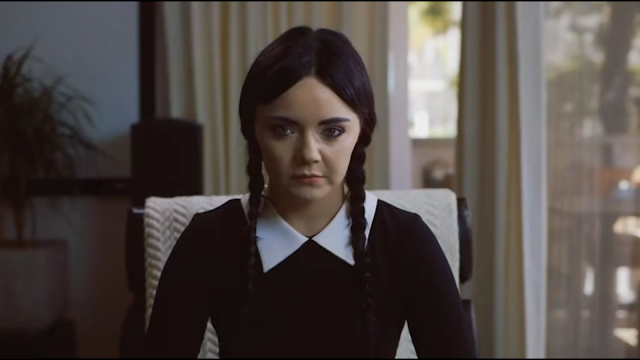
It's Wednesday. We deserve a treat. If you've seen these before you'll be glad for an excuse to see them again. If you haven't... what crypt have you been hiding in?

I started out planning a post filled with songs about Wednesdays but no-one writes songs about the middle of the week. Or not good ones. Then I thought of this.

I was a little surprised to see both seasons were still up on YouTube. I thought they'd been taken down long ago.

I hate to get all nostalgic but didn't the web used to be fun? Or more fun, anyway.

 I mean, we had Adult Wednesday Addams, Poppy, Pronunciation Book...

Is there anyone still doing stuff like that? If anyone knows, don't keep it to yourself. The comment section is right down there.

 And that's the whole of the first season. Someone remind me to post Season Two for Halloween.

Monday, December 28, 2020

Binge Watch Sorrow?


Wilhelm
has an excellent post up at TAGN, looking back at a year of what he describes as "binge watching" but which I would probably just characterize as normalized twenty-first century viewing habits. It's such a well-structured piece I mentioned in the comments that I planned to steal the headings for a cover version. And so I have.

  • No commercials is pretty nice.

Yeah, that's one thing we already kinda know, here in the UK. I grew up watching tv without commercials (or, as we used to call them, and as older people still do, "adverts") because about ninety per cent of everything I watched was on the BBC. It was a class thing to some extent, the way everything in Britain is a class thing (everything in the world, actually, only most cultures aren't as comfortable about saying so, openly). It was also an education thing. 

My family being weirdly muddled about class the way a lot of families were in the sixties and seventies, we used to watch ITV sometimes but we felt bad about it because watching "the commercial channel" was something the lower classes did. (We only had the one back then and come to think of it, why did we call it "the commercial channel" but call the commercials "adverts"?).

Actually, that's post hoc rationalization. I was a child and I didn't think about stuff like that and my grandparents, with whom I grew up, were Quakers from a rural and working-class background, who I never heard mention "class" at all. My mother wore mini-skirts and rode around on a Lambretta like she was expecting David Bailey to pop out of a hedge at any moment so I don't imagine anyone around me was heavy into sociological placement theory. We just didn't like our shows being interrupted by commercials. Seriously, who does?

  • I still won’t buy pay-per-View.

Me neither. In fact, to date I never have. I've thought about it a few times but so far there's never been anything I felt I couldn't wait a little longer to see. Or a lot longer. Or never see at all. 

I will buy virtual, though. I don't like to. I prefer to buy on DVD (Yes, still. And I don't even have a Blu-Ray player so it really is DVD) for reasons that I'll cover in a later bullet point. It annoys me that, as Wilhelm says, you never really own anything you buy digitally and in practical terms I'll probably never get around to re-watching stuff I buy that way anyway, so the difference between buying the one-off option to watch it on pay-per-view and "owning" it is notional at best... but there you are. I never said I was rational. 


  • There are too damn many streaming services.

So infuriatingly true.  There are way too many streaming services, each with their own exclusives, but worse still they aren't all available in all territories and even when they are some of them operate local programming. I would dearly love to be able to watch all of the shows that used to be on DC Universe but before that even got rolled out to the UK it got rolled up into HBOMax, which is unlikely to launch here until at least 2024 because of HBO's existing contract with Sky and I am damned if I am going to subscribe to Sky in this or any other lifetime, not even to watch the Legion, which I think got cancelled before it got made, anyway.

Then there are the sub-streams. What even is "Starzplay"? I already subscribe to Amazon Prime. How is it they're showing me stuff from a supposedly separate service to which I have to subscribe yet again? Do they own it? If so, why isn't included? If not, why is it even there? I managed to get around it the first time by taking the free trial for a month so I could watch the only Starzplay show that interested me, Doom Patrol, before cancelling without having to pay but that trick won't work for Doom Patrol season two, which I have variously heard is better/as good/not as good as the first. I'm going to have to wait until it comes out on DVD.

I already have too many subscriptions. Let's see... for games I have Daybreak's All Access and I haven't cancelled World of Warcraft yet although I probably should. For media I have Amazon Prime and Netflix. There's also a hosting service for Mrs Bhagpuss's business website, which I pay for, for some reason, and our ISP, which she does. Do I want any more? No I do not. But I bet I'm going to end up with some, anyway.

  • Finding things is hard.

Isn't it, though? Wilhelm was talking more about the problem of knowing what to watch next but as I said in the comments, I've found other bloggers to be a more than adequate source of recommendations. No, what I find unecessarily difficult is navigating the totally useless interfaces someone seems to imagine are aesthetically pleasing and functionally valid. Which they are not.

Seriously, can anyone find anything on these these shuffleboards? It's all lines of categories that make no sense even if the same dozen shows didn't just replicate over and over across all of them. Why is it we hear so much about algorithms and AI and how they're going to replace human thought and yet at the same time everyone complains constantly about how fecking useless they are? 

All I really want is a basic, searchable a-z list. Is that so hard? I want to be able to type "sitcom" into a search field and get an alphebetized list of every sitcom on Netflix. If I could then narrow down my search by keywords, like "1990s" or "US" or "New York" that would be aces but honestly I'd just settle for plain, vanilla a to z.

Someone's going to pop up the comments explaining how I can already do that, I bet. I hope so...


  • I am torn on weekly versus all at once content.

Me too. Although "torn" is putting it a bit strongly. I'm skewed heavily towards "all at once". In theory I have some lingering nostalgic affection for the days when I'd meet up with friends and we'd get drunk arguing over the latest plot turns in some tv show or other. Or when a conversation would start up at work about some sitcom relationship development and everyone would take sides.

Was that really all that great, though? Or was it just something we did? And people still do do it where I work only they do it about shows I don't watch and movies I haven't seen. And really, it doesn't make any of them sound all that interesting. The people or the shows.

Against that, there's the truly huge benefit of actually being able to remember, in detail, what happened not just in the previous episode but the previous season. In the days when we all used to watch this stuff as it was broadcast it would have been a week since you saw the last episode and maybe a year (or several) since you saw the season where the current plot developments were set in motion.

Condensing a decade of broadcast television into a few weeks or even a few days of concentrated viewing is a genuine, intellectual paradigm shift. It brings the architectonics of the form into clear relief. I can see how the whole thing works and that's glorious. It adds a whole new level, creates a deeper texture, makes everything matter more. 

Movies always worked this way. You commit yourself to their reality for a fixed period as your own slides into the background. Emotional connections and reactions are heightened. Reality bends. It's one of the reasons cinema was taken so very much more seriously than television for so long. Now that gap has narrowed. About all that cinema has left is the communal experience and since the pandemic not even that.

  • We have been biased towards shows versus movies.

Following on from the last point, what tv shows have that movies don't is length. A very, very long commercial movie (shut up Andy - I said "commercial") might run three and half hours. Even a very short tv series runs twice that long and many hit three figures. There used to be a trade-off between length and quality but those days are long over. Now you get movie quality at tv length and there's a feedback function whereby sustained quality for longer produces even higher quality, at least in terms of emotional engagement. 

I could hammer out a list of fifty, a hundred movies that I love and which have affected and moved me deeply but in all but a handful of cases I can't pretend I have an imagined emotional relationship with their characters the way I do with the dramatis personae of Buffy or Parks and Recreation or Roswell or Bojack Horseman... or even frickin' How I Met Your Mother, which I'm seven seasons into right now and all of whose characters I would happily slap, vigorously and repeatedly, with a wet fish, and yet who feel, bizarrely and disturbingly, like people I somehow actually know.

So, yes, tv shows over movies for me, right now. It'll change if and when I want to get my emotional hit in concentrated form rather than slow release. Bound to happen, sometime.

  • I could cut the cord were it not for sports.

Well, for a start, I don't have a cord. We don't have any kind of cable contract and never have had, even though we do, quite literally, have "cable". We've had a fiber-optic connection since the mid-90s, when the city we live in was an early adopter of the technology. It's one of the reasons we haven't moved yet. But we've never used it for anything other than the internet.

As for sports, the only one I'm really interested in is cricket and I only like to listen to that on the radio.

  • It really sucks when the internet goes down.

Yeah, it does. Fortunately, that's very rare in our house. And we do have other options, namely several hundred DVDs. Because we're old people, so we still buy those. In fact, we buy DVDs of the same things we watch on streaming sevices and then we watch them on the streaming services and don't watch the DVDs, which often we don't even take out of the shrink-wrap. Because as well as being old people we're also pack-rats and we like stuff we can touch. And hoard. And paw over.

Of course, as anyone who's ever played an mmorpg knows, the moment you lose access to something you can't think of anything else other than that thing even if before then you weren't thinking about that thing at all. So having a load of offline options really only works when the internet isn't down so, yes, it really sucks when that happens. 


  • It does not replace the theater experience.

No, it does not. But then, it's been a long time since I went to the theater. Actually, it's been a very, very long time since I went to the theater, because over here "the theater" is not what we call the place they show movies. We call that "the cinema". The theater is where people walk about and project and you have to use opera glasses if you want to see their expressions (Except, naturally, it's not the opera, either. Who names this stuff?).

In the 1980s I went to the movies every week or two. In the nineties that dropped to every couple of months and by the turn of the millennium I was down to two or three times a year. Of late it's been an annual outing with my friend on one of our birthdays and some years we don't even manage that. And yet, I agree, watching movies at home doesn't quite equate to seeing them in the dark with a bunch of strangers. Will that ever happen again? For some people, surely. For me, this last year may have broken my habit for good.

On the other hand, my mother, who is eighty-eight years old, has been going to the cinema almost weekly since the 1940s. She's the one who's been missing the live cinema experience during the pandemic. So it's not just a young person's thing. Maybe I'll follow her example and get back to the cinema on the regular when I retire. If there are any cinemas left by then.

  • I still cannot watch exactly what I want on demand. 

See above. This is a real problem because we are all spoiled babies who have to have everything we want right now. Or maybe because in an age of digital technology it should be possible to have all of human creativity immediately accessible to everyone at the click of a button. One of the two.

And, honestly? I'm okay with some shortages in the supply chain. I grew up in a world where you counted yourself lucky if you even happened across an article in a magazine that mentioned some movie or tv show or record album or book that sounded like it might be something you'd get excited by if you ever managed to find it, which you had to assume you never would if it was any older than that year, or that month, or that week, depending on the medium. 

Your chances of experiencing almost anything first-hand were infinitesimal and you knew it, so imagine how utterly stoked you'd feel when, once in deep blue moon, incredibly, unbelievably, serendipitously, you'd stumble, in a flea market or a yard sale, upon a copy of something you'd only ever heard about. Or when you switched on the tv late at night and saw an elusive title roll across the screen....

Yes, I'm very much happier that nowadays I can discover anything from the last hundred and fifty years from the comfort of my chair, read about it in depth and in detail, for free, then order a copy to stream on my screen immediately or be delivered to my house the next day. That's how it should be. But it's still nice, just once in a while, to have to work for it. And maybe it's good to know that, just very occasionally, there are a few things that will remain forever out of reach.

I mean, we can't always get what we want, right? But we can try. And, sometimes, we get what we need. Kinda...

Yeah, no. Gimme it all and gimme it now.

Wednesday, March 11, 2020

Get Older

Kim at Later Levels was wondering when, if ever, someone might be considered too old for gaming, after someone watching her and her husband Pete stream asked how old they were. Naithin at Time to Loot picked up the theme and both posts generated a lot of comments, pretty much all supportive of the idea that you're never too old to play video games.

My position, unchanged to any significant degree since I was a teenager, is that when it comes to culture and entertainment everything is for everyone and it's no-one's business to try and tell anyone otherwise. Of course, for all recorded history there's been no shortage of people who want to do just that.

At the extreme we have the kind of hysteria codified in Stanley Cohen's 1972 treatise "Folk Devils and Moral Panics". In the U.K. in my lifetime I remember outbreaks of outrage and fear over mods and rockers, "video nasties", dangerous dogs and Dungeons and Dragons, just to name a few.

These intense eruptions of public paranoia, always media-driven, flare up and die away, usually when they cease to drive sales. Occasionally they leave behind them some rushed and ill-considered legislation but more often their only legacy is as a curious footnote in cultural histories.

Much more insidious are the underlying trends that simmer and bubble just beneath the surface, never quite boiling over into outright panic but always stoking a feverish discontent with the behavior of others. The veneer of popular authority conferred by such "normal" views feeds the belief in certain individuals that it's okay to tell people how to spend their leisure time and to critique those who don't choose to use it "productively".

This is something I know more from observation than personal experience. Self-analysis is infamously unreliable but I would like to think that anyone who's ever had the temerity to suggest they knew better than I how I should spend my time has gone away regretting they ever mentioned it. I've rarely been one to suffer from self-doubt and almost never when it comes to my cultural choices.

I have also always been fortunate enough to move among peer groups that tended to think along the same lines. At school, at university, in my strongly-socilaized twenties and thirties, I mixed almost universally with people who liked nothing more than to be introduced to new ideas - unless it was arguing about their relative merits.

There was always a hierarchy. Every type of entertainment or art was valid but some were more valid than others. In my social circle an interest in sport was considered a tad déclassé, science fiction was deemed to be inherantly superior to fantasy and music came with so many signifiers you needed a chart to navigate the potential reefs that could punch a hole in your credibility.

In that hierarchy, the two cultural activities that always bumped along the bottom were video games and table-top role-playing. Which isn't to say no-one in my circle gamed or role-played; several did, including a number of core movers and influencers.

Even though gaming wasn't considered all that interesting by most of the community, no-one ever suggested that anyone shouldn't do it. I find it hard to imagine the concept of curating someone else's experience in that way even arising as a theoretical possibility. People did what they did and that was all there was to it.


The crucial and barely forgiveable sin was being boring. If you were going to insist on bringing topics to the table that didn't interest most of the people around it then you'd damn well better make certain you made them interesting. I still find that a good rule of thumb.

When I started playing EverQuest in 1999 it marked the end of my social years, already in steep decline through the '90s. At a certain point many people, myself among them, find they just don't have the energy any more to spend most days at work and most nights out of the house, drinking, dancing, watching bands and movies and everlastingly, neverendingly debating the merits of every last notion.

At least, discovering MMORPGs marked the end of one kind of socilization - the direct, face-to-face, in person kind. It was replaced by an asynchronous, partially anonymized set of interactions the world was soon to adopt as "social media".

I was forty when I started playing EQ. By then I'd been playing video games for twenty years. Mrs Bhagpuss and I played more video games in our forties and fifties than the children in the house. Even at the turn of the century most of the people we met and grouped and were in guilds with in game after game were not adolescents. Most of them weren't even students. They were adults, mostly a little younger than we were, not infrequently quite a bit older.

When I turned to blogging the question of age simply never occured to me. Blogging does not seem to me to be an activity that comes with an age limit, either up or down. It's writing, isn't it? When was writing ever the property of a particular age group?

I read a lot of "Young Adult" novels. It's a publisher's term that really means books aimed at readers in the early to mid teens. Actual young adults from sixteen onwards are rarely seen browsing the YA shelves.

A certain strand of YA publishing is written by and for people for whom reading and writing is a form of identity in much the same way "gamer" is. In those books the lead character often blogs. Or used to blog. Or is planning on blogging.

I suspect that's because the authors are generally ten to twenty years older than their target audience and blogging was what they did when they were in their teens. My guess is that very soon those blogging protagonists will turn into vloggers or streamers as a new generation of YA authors comes through. Blogging in the classic sense may well become the prerogative of the "old", by which I mean what I've always meant by that word - anyone over thirty.

With all that in mind, I was rather surprised when Kim replied to my comment, in which I observed "I read a lot of gaming blogs and not many of the writers are under thirty these days. A lot of them are 40+" by saying "It certainly seems like the majority of bloggers I know are between ten and 15 younger than I am". She doesn't give her exact age on her blog (and why the heck should she?) but judging from her comments and the photo I would guess she's mid-thirties at most.

In this corner of the blogosphere I think that would put her about bang in the middle. I think I have a rough idea how old most of the more active bloggers in my blog roll are - everyone tends either to mention their age or date themselves by implication at some point - and I doubt there are more than a handful who have yet to turn thirty.


At 61 I think I might be the oldest. I could name several bloggers on that list who're in their fifties and a good few more in their forties. Obviously I'm not going to do that. Why would I? None of this is about age, after all. It's all about interest and aptitude.

In a reply to something Marathal said in the comments on Naithin's post I wrote of playing games "I’m looking forward to having even more time for the hobby when I retire. I’ll stop when I lose interest or when I’m physically incapable and not before". I'd say the exact same about all of my interests, from driving to traveling to walking to reading to music to movies.

What's more, I plan on reading and watching and listening to whatever takes my fancy, with total and complete disregard for what the intended audience might be. Legal restrictions excepted, when it comes to culture everything is for everyone, or it should be.

And the best can be found anywhere. Anyone who thinks the imprimatur of the Canon or the authority of academia ring-fences quality is mistaken. Previous acceptance and ongoing interest is a pointer but not a promise and someone always has to be the first to discover the new best thing. As Bill Watterson so memorably said, there's treasure everywhere.

What's more, you're never too old - or too young - to look for it, to find it or to tell everyone else about it. Game, blog, stream, all of it, if that's what you want. However young or old, whatever others might try to tell you. Act and speak with conviction and clarity and your choices will be accepted. Never doubt your right to be who you want to be, do what you want to do, say what you want to say.

Just be prepared to live with the consequences.

Wider Two Column Modification courtesy of The Blogger Guide