At nearly sixty-five years of age (This month!) I must be about as late to the anime party as anyone. I have to wonder why it's taken me this long to get here, especially when you consider I was fending off friends and acquaintances determined to persuade me Japanese animation was going to be the next big thing as far back as the early '90s. Actually, now I think about, that's almost certainly the reason.
There was a surge of interest in the genre (Is it a genre?) among my then-peer group even before that. I think it began as early as the late 'eighties. I remember Akira doing the rounds of the art house cinemas around then before it turned up on TV not long after, to much hype and ballyhoo. I remember watching it and thinking it was okay but not really being able to see what the fuss was about.
It didn't help that the people I knew who were really into anime (And manga.) back then exhibited a kind of quasi-religious mania about it. They seemed determined to proselytize and it was counterproductive, at least with me.
Life Lesson: never go too hard when trying to share your new obsessions. A few
hints and a seeming unwillingness to go into detail gets people curious
enough to look into the topic for themselves. Everyone loves to feel they're the ones who discovered something new and
wonderful, not that they're just following some trend. (See? I can give advice
just fine. It's taking it I'm bad at!)
The upshot was that I mostly turned my back on the form (I like "form" better than genre.) for a quarter of a century or so. Over the years, active resistance decayed into indifference before finally crystallizing into curiosity. I could have saved myself a lot of wasted years by just being more open-minded in the first place but that applies to a lot more than anime.
In the end it took the advent of streaming services to break down my last residue of reserve. The damn things were right there in front of me every evening. All I had to do was click on them. Why not?
Of course, I still know absolutely nothing about the form (Sticking with that.) so my picks have been hit or miss to say the least. I've been happy to receive advice and suggestions both from commenters here and from people at work who've been steeped in this stuff for years but in the end I've mostly been using the same methods that have always served me so well in other media, by which I mean choosing books by their covers and bands by their names.
I've had the Crunchyroll app installed on Kindle Fire and the website bookmarked on PC for years now, but the choice there is so overwhelming I bounce off it every time I look. Mostly I'm happy to make my selections from Netflix and Prime, where a lot of the curation has already been done for me.
I'm also well aware the correct way to watch all non-English language movies
and TV shows, animated or live action, is with subtitles but at this stage of
life I really don't care so much about authenticity as I do about being
entertained. From a practical perspective, dubbing is far less intrusive in
animation anyway. The distracting mismatch between the shape of the mouth and
the sounds coming out of it either already exists or isn't relevant. Who knows
how a talking rabbit's mouth would work? Added to that, the voice acting on
just about everything I've watched has been very good, so why not enjoy it?
The upshot of all of this is that my initiation into anime has been both hopelessly populist and steeped in ignorance, an approach which I think may, ironically, work in my favor. When I saw "Carole and Tuesday" I knew absolutely nothing about it. I had no idea it was by the same person behind the magnificent Cowboy Bebop. Obviously, had I known that, I would have been expecting greatness, which is precisely why I try not to know anything about what I watch until after it's over. Nothing dampens an experience faster than unrealistic expectations.
If I knew nothing about its provenance, why did I decide to watch the show?
Simple.
- It was on Netflix.
- I thought the title sounded really cool.
- It was about contemporary music.
Only two of those things turned out to be true.
I'm looking at the Overview and First Season Episode descriptions on Netflix
right now. It isn't until Episode Seven that there's even a hint that the show
takes place anywhere other than the here and now. And even then it's
vague and ambiguous.
Carole and Tuesday is set in the future, on Mars. It's SciFi. That came as a big surprise. You would think someone might have thought to mention it when writing the promotional material but apparently either no-one thought it was relevant or they assumed anyone interested would already know. There's also no suggestion that the show carries a strong and coherent social and political message throughout, something that's there in the background from the start but which comes front and center for the whole of the second season.
The high quality of the music should perhaps not have come as such a surprise
but it did, anyway. I have a YouTube playlist from the show running as I write
this and every song I've heard so far works perfectly as polished pop even
without the visuals. That said, the impact of some of the songs is orders of
magnitude greater when you see and hear them in their correct narrative context.
I already gave my thoughts on the first season, which I loved. I wondered whether the second could sustain the quality and the good news is that it absolutely could. The bad news is... no, there isn't any bad news. It's all good.
Well, unless you count the fact that there are only two seasons. It would be nice to have more. But even then, it's good to have a real ending and Carole and Tuesday has one, provided that, like me, you like endings that are really beginnings.
Season One very much sticks with the the premise of the show, which is that two young musicians meet by chance, fall into performing together, get noticed, start building a career and after many setbacks and some triumphs, succeed.
"Success" in a musical career can only ever be a starting point, though, so
Season Two begins with the pair not that much further forward than when they
began. Rather than simply carry on the same story, Season Two opens
out the backstory to reveal much more of the world in which the two girls live
and offer some hints about how it came to be the way it is.
Along the way the two leads learn much about themselves, change the lives of
others and finally change their world. It happens on another planet and in
another time but it feels as real as if it had been the contemporary tale I
was expecting. The show is in no way an allegory but it's rich in allusion to
events, atitudes and issues familiar to us all from our own histories, both
personal and cultural.
As a narrative it's coherent and always plausible. The setting is a heightened reality but a completely convincing one. As with most anime I've seen, (Pitifully few.) there's almost no exposition and very little explanation. For me, that's one of the form's most appealing features, although I imagine others may find it frustrating.
Thematically, the show brings in issues of pollution, gender, political corruption, sexuality, race and identity, embedding and entwining those themes in the narrative, always allowing them to emerge organically from character and setting. The social and political concerns never unbalance the core story of two girls trying to make it in the music industry and how many of those situations came to be is largely left to the viewer's imagination.
Emotionally, Carole & Tuesday is satisfyingly complex, with multiple characters revealing surprising aspects of their personalities and pasts, often without feeling any need to elaborate on them. It's an exhillarating choice, leaving the viewer feeling they've glimpsed a life in passing, like overhearing a snatch of conversation on the street.
Relationships between characters, ranging from friendships to romance to familial obligations and more, are all uniformly well-handled with both sensitivity and maturity. There are few if any simple characters in Carole & Tuesday. For an ostensibly teen-oriented story, the whole show feels remarkably adult, in the most positive meaning of the word.
I found the girls' rival, Angela, particularly impressive in her testing journey to self-knowledge but almost every character, major and minor, made an impact that stayed with me. Writing this, I find myself remembering many of them in much more detail than I would normally retain this long after watching.
It would be typical of me to finish without mentioning the animation itself. Somehow, even though I find animated art intensely emotionally involving, frequently responding to its color and movement with a visceral, even a physical reaction, I tend to skate over all of that when talking or writing about it. I'm better at interpreting and describing static comic art than moving pictures. Well, more comfortable, anyway.
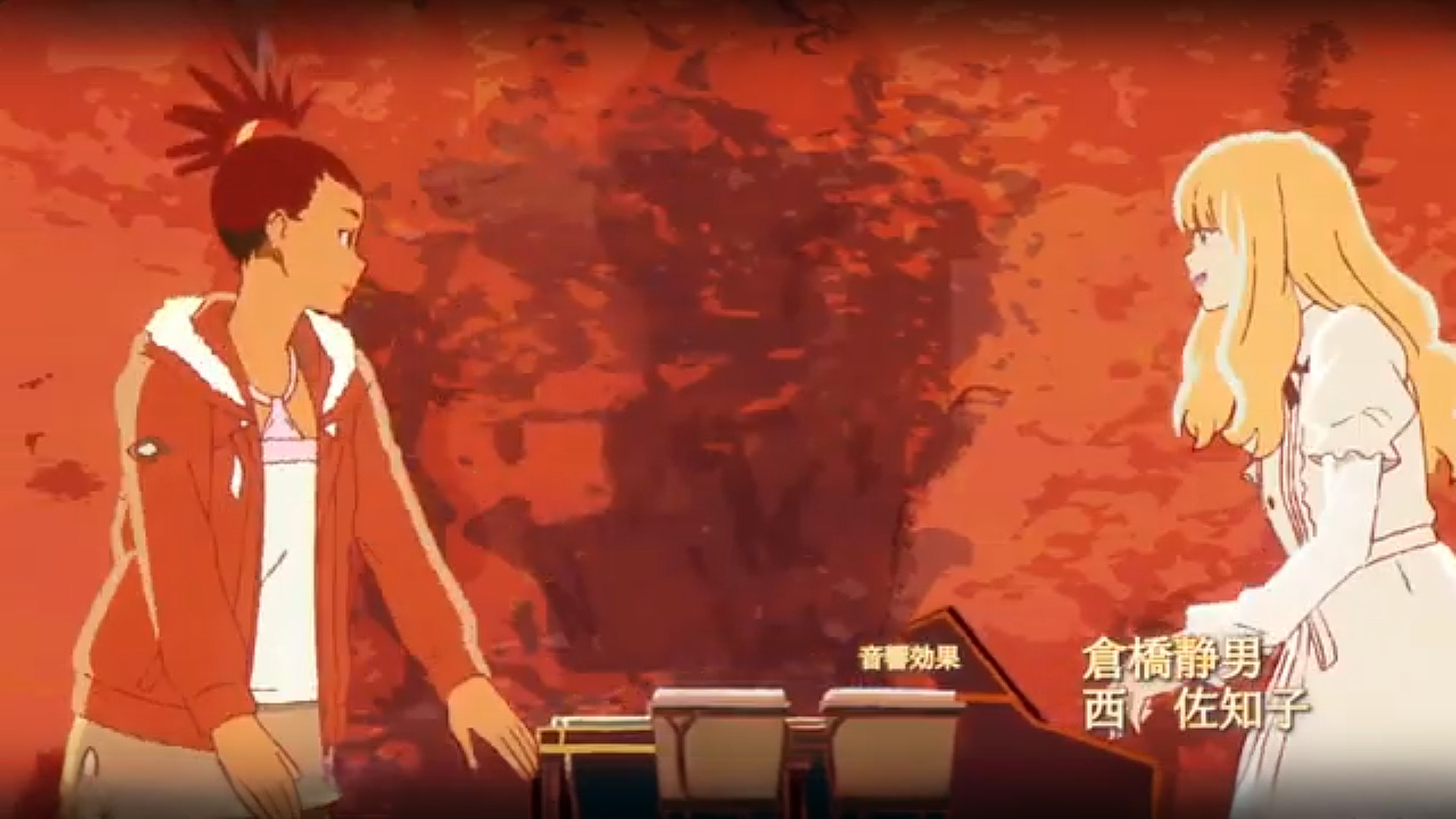
So far, the standard of animation in all the anime I've watched has been exceptional, as have the aesthetics. Even in my small sample the variety has been astonishing. Carole & Tuesday reminds me of a particular kind of 1960s-70s picture-book illustration, with its clear lines, pastel flats and unmistakeable jazz sensibilities.
All of that is exemplified in the sublime opening sequence that introduces
every Season Two episode. Coupled with one of the most lyrical and ethereal of
all the show's excellent songs, it's one of the most impressive opening
sequences I can remember. I watched it in full before every episode and I've
watched it several more times since, just for the joy of it. I included it in a previous post and I make no apologies for sharing it again.
I'm sure I'll be watching the whole series again, soon and more than once.
It's a great show. I reccommend it unreservedly.
Carole and Tuesday set such a high bar that I thought the next anime I watched would have little chance of clearing it. The next anime I watched turned out to be Beastars, so I was wrong about that.
But that's a tale (Or a tail.) for another time.


 Posts
Posts