Friday, May 17, 2019

Playing Dead : GW2

Let's get this straight from the start: this post has SPOILERS. If you haven't played Guild Wars 2's latest Living World episode, War Eternal, and you don't care to know what happens then LOOK AWAY NOW!


Thursday, May 16, 2019

Never Satisfied: GW2

When I decided to throw a quick post together about Guild Wars 2's latest Living World update (Season Four, Chapter Six for those keeping score), I was going to do the usual thing of avoiding spoilers but when even the name of the new map gives most of the game away it hardly seems worthwhile worrying.

The map's called Dragonfall and Jeromai has some great widescreen shots of it. He's also very enthusiastic about what he's seeing. I'm... less so.

Yes, the art department has done its usual superb job. This is top notch scenery. It's also the same scenery.

It's a bit cavalier to complain about consistency, isn't it?. After all, I'd be just as likely to complain if the pieces didn't fit together, wouldn't I? And isn't one of GW2's strongest suits the way the worldmaking manages to avoid the pitfalls of so many MMORPGs by maintaining coherent and geologically believable transitions? 

That's not really what I mean, anyway. "Consistent" and "same" aren't synonyms. And the new map is beautiful. Stunning, even. I particularly love the verticality that brings back such good memories of Heart of Thorns.

I don't mind the kitchen sink approach that grandfathers in every previous movement system - bouncing mushrooms, lava tubes, whirlwinds, ley lines, updrafts, even those vines that turn you into Spiderman. Although, as I worked my way around the strikingly different subdivisions last night, I did get the distinct impression someone wanted to show off every tool in the box.


And I did enjoy myself. It was fun. It's good work and I appreciate it. I just didn't hear myself go "Wow!" I'm not sure I will, again, not until we go to somewhere truly new. And even then I suspect it will feel surprisingly familiar.

Wherever it is that we end up in Season Five or Expansion Three (if there is one) there'll be places that look as though they were designed by the world's most talented six-year old: sparkles and stars and twinkling lights as far as the eye can see. There will be the areas that look like the covers of prog rock albums from the 1970s, specifically the ones designed by Roger Dean and Rodney Matthews. 


There will be an immense reliance on deep hues that make every screenshot look like something from the Color Field playbook. The rest will be a mix of stuff that's on fire or dragged up out of the sea or frozen solid or baked dry, just like every other MMORPG only with seriously better production values and far more attention to detail than most. I'm finding it something of a challenge to get excited by any of that any more.

For all the technical skill on display, have any maps been added to GW2 over the last seven years that can stand comparison with the greatest cities of the core game, Divinity's Reach, The Black Citadel or Rata Sum? Does anywhere feel as timeless and true as the eternal autumn of fallen Ascalon?


I do love all the maps that came with Heart of Thorns but even I wouldn't claim they're as complex or complete as those that preceded them. A jungle is a jungle in the end, even if most of it does feel more like a forest.

There's no obvious solution to this problem, if it's even a "problem"that exists outside my head. Most MMORPGs end up being more of the same. We've seen the trouble it can cause when they try not to. Having one of the best art teams in the industry with a portfolio of immediately recognizeable signature styles is as likely to emphasize the issue as conceal it.

Oh well. There are plenty of worse problems to have.

Just ask the writers.

Wednesday, May 15, 2019

Makes No Sense At All: SW:TOR

Star Wars: the Old Republic has a lot of story, most of it delivered by typical MMORPG quests. They aren't called "quests", of course. SciFi games have "Missions". Call them whatever you like; if you're following the plot, you're going to have to talk to plenty of NPCs. And all of them want something.

Every Mission begins with a playlet. The NPC talks and you listen. Then it's your turn to reply. A dialog wheel offers three (or, rarely, two) choices. It's meant to make your progress along the pre-determined path seem less inevitable.

As well as making you feel like you have some say in what's happening, there are, supposedly, potential repercussions to make your choices meaningful. Your Companions might like or dislike you more depending on what they hear you say. Your slider might move up or down the Light/Dark scale.

These are things that sound like they might matter. They don't.

Last night my Agent managed to piss off her companion, Kaliyo Djannis, so badly I thought there was going to be a fistfight. Kaliyo threatened eternal enmity then my agent gave her some trinket she found in the bottom of her bag, Kaliyo gosh-wowed her thanks and the two of them went off to do another Mission together as though nothing had ever happened.

I wasn't surprised. It was established a few posts back that nothing you do makes much of a difference. In later expansions, I hear, miffed Companions can storm off and never come back but in the core game the most they can manage is empty bluster.
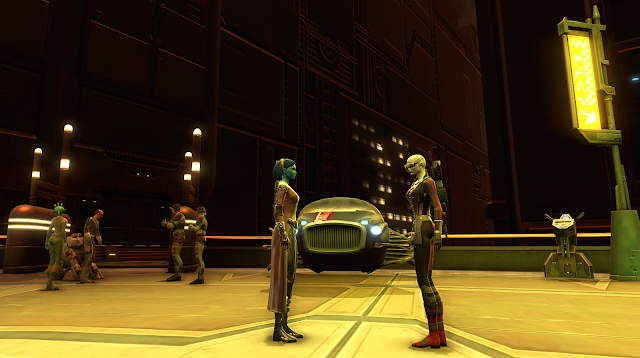
If we're going to settle this with a staring contest, Kaliyo, you're going to have to take thos ridiculous glasses off.

Companions' opinions are irrelevant. The Light/Dark system is purely cosmetic. There's still the narrative, though, right? Your moral choices must be stacking up to something there, surely?

Nope. Not so far as I can tell. Do what you want: all Missions have the same outcome, regardless, because whatever the Player Character decides is just fine and dandy with everyone involved. Execute or excuse, imprison or pardon, help or harm. No one gives a damn. You did the job, here's your pay, now let's all get on with our lives.

Oh, your handler or your boss or whichever random NPC handed you the job for absolutely no explicable reason in the first place may kick off for a moment but they'll always come around. At most it might take them a few hours before they realize they were wrong and you were right.

On a couple of occasions it's looked as if I might have made an actual enemy. No such luck. Just wait. Even if they left mad, soon enough mail will arrive explaining how everything turned out alright in the end. With a cash bonus attached, just to thank you for being so clever.

Playing a Light-inflected character on the Republic side, the anomalies were easier to handwave away. I was working with the grain. Sure, it was disconcerting to hear my Smuggler spouting homilies about sparing the innocent only seconds after she'd slaughtered forty or fifty data entry clerks for a Bonus Mission, but that's MMORPGs for you. At least Stealth meant she didn't always kill everyone that got in her way.

If it's relatively easy to  look the other way when my Smuggler's halo slips, playing Pollyana for The Empire takes a blindfold. The game wants to offer everyone equal opportunities to win Light or Dark points but it's a lot easier to be a loose cannon on the good team than a saint on the bad.

Where indeed? I'm basically The Empire now, right? What exactly is it the rest of you do, anyway?

Taking the the path I've chosen, Mission after Mission ends in an outcome that ought to see me on trial for treason, always assuming someone didn't just shoot me dead on the spot. I could cite literally dozens of cases because, to a greater or lesser extent, it happens almost every time but I'll stick to one particularly egregious example.

I'm jogging down some corridor when someone from the upper echelons of the Empire's military hierarchy buttonholes me as I pass. As usual he's mistaken me for Supergirl. He explains that Revan (aka The Ravanchist aka Revan the Butcher aka Darth Revan) left an active but abandoned facility on Nar Shaddaa. It's guarded by seemingly inexhaustible autonomic defenses that The Empire has been trying - and failing - to breach for years.

In the attempt they have lost a thousand men and ten thousand droids. He quotes those exact numbers. He's convinced I can do better. On my own. With no preparation. Now.

Plenty of Missions have set ups as utterly ridiculous as this but the set-up is the least of it. Off I go to do what a literal army hasn't managed in a decade of trying. And I succeed because it turns out I am indeed Supergirl, assuming  Supergirl solved every problem with a burst of automatic gunfire.

I take out all the defenses then I trot back to the military man to tell him the good news. He musters the troops and sends in a strike team to secure the target they spent all those years and lives trying to secure.

Oh, wait, no he doesn't! because that would make sense! What he actually does is ask me to go in, alone, find out what's there, then come back and tell him. So I do.

10,000 droids and little ol' me.


I find nothing much. Only a few aliens, the remnants of the slave force Revan brought in to run the facility. They're not aggressive so I'm not allowed to shoot them.  Not until I get that dialog option, anyway.

I talk to them and they explain they're maintaining something called The Infinite Engine. I could choose to kill them and take it or accept their gift of a "fragment" that will eventually grow into a new engine. If I do the latter the implication - no, actually, the stated outcome - will be peace and continued, unchallenged occupation of the facility for the aliens.

Being Little Miss Goody Two-Shoes I opt for the fragment. I take it back to the officer who sent me. He's not impressed. "Is that all you found?" he asks, looking at the speck of who knows what I've handed him. I assure him it is.

"Oh, well", he says. "Fair enough. I'm sure you did your best. Here's some money. Buy yourself an ice cream". Or words to that effect.

Excuse me? You're a (presumably) senior officer in the armed forces of a galaxy-spanning military dictatorship, who spent years of your life, a thousand of your men and ten thousand of your machines trying to get inside this place, but now you're going to take my word for it that there's nothing in there worth bothering with? You don't want to take a look for yourself? Send in some experts? Get some photographic evidence? You're going to leave it at that, walk away, never think of it again?

Are you clinically insane??

Seven hundred and ninety-seven credits? Seriously? I guess you blew the entire budget on those droids.
 It would be one thing if this was a freakish exception but it's so very far from that. It's pretty much the standard result when my Agent does anything you'd imagine she'd be put in irons for suggesting. In my experience so far, the player character can literally do no wrong. It's like living under some sort of reverse curse, where everything that can go wrong... doesn't.

I understand the gameplay reasons behind it. Most MMORPGs do something similar, if rarely so blatantly. The problem is that TOR's reputation rests in considerable part on the quality of its storytelling and as far as I can see, this blows that reputation out of the water.

Long before the end of Chapter One, my Agent should either be dead, on trial, in prison or on the run. Her name should be on Most Wanted lists across The Empire, her face on posters, every guard primed to arrest her on sight. Instead her reputation for reliability and efficiency grows and grows and she's entrusted by more and more important people with more and more important tasks.

I understand she's supposed to be an improviser, an innovator, a self-propelling bomb. I understand that results matter more than methods. What I can't understand is how any of that allows her to get away, repeatedly, with doing the exact opposite of what she's been ordered to do. Once in a while she'll lie to cover her tracks but mostly she just strolls back in and tells her superiors to their faces that she's disobeyed them and they'll have to put up with it. And they do!

Maybe this is all going to turn round and bite her later on. Maybe I'm just not seeing the long game BioWare are playing here. We'll all have a good laugh when I find out just how hard they pulled the wool down over my eyes.

Or not. I'm betting on not.

Sunday, May 12, 2019

Goo Goo Barabajagal: SW:TOR

Three weeks ago, when I decided, pretty much on a whim, to give Star Wars: The Old Republic a try, I didn't expect to enjoy it anything like as much as I have. I'm still playing just about every day, although the relentless narrative drive does mean I have to stick to shorter sessions than I might in a less obviously structured game.

The sheer volume of story is quite astounding. I've put in more than eighty hours so far and I'm still on Chapter One of both the Smuggler and Agent storylines. I must have spent ay least a quarter of that time on the main plot, so let's say twenty hours, split 60/40 between the tow characters.

As far as I can tell, without reading anything with spoilers, all the original Class stories have three chapters and it looks as though they're roughly the same length. That would mean each class story would run somewhere around thirty hours.

There are eight of them, which comes to two hundred and forty hours of story, the equivalent of four to six complete AAA RPGs, given people generally expect those to have forty to sixty hours of content.

That's just me, though. I go really slowly. I still haven't used Quick Travel and I still don't own a speeder. I run everywhere and it takes forever. I could probably cut my hours taken significantly if I took shortcuts like those.

According to this 2018 Reddit thread, other players estimate fifteen to twenty hours per Class story. That sounds a lot more reasonable but it still brings the total in at 120 to 160 hours of gameplay, several times the length of a typical single-player RPG.

And that's just the core game class stories. The Planetary Story Arcs must add another RPG or two, not to mention all those Exploration Missions BioWare included back when they still thought they were making a regular MMORPG. And the Heroics, although, to be fair,  those tend to be more fist to face than face to face.

Someone had to write all that. And then someone had to say it all out loud. More than two hundred someones, actually.

At launch, TOR took a Guiness World Record for most voice acting in a video game. That must have had a great deal to do with the spiralling costs, believed by some to top half a billion dollars but agreed by just about everyone to be more than $200m.

With that in mind I can't work out whether it was belated fiscal prudence or creative burnout that led to the bizarre decision to have large numbers of NPCs spout nothing but incomprehensible gibberish.

Uncharismatic speaking-in-tongues becomes increasingly irritating the longer you have to listen to it and with this amount of narrative that's a serious problem. As Pallais pointed out in the comments to the post about playable species, "Even with subtitles, the average person gets weary of not being able to understand the character, especially since in Star Wars the same nonsense phrases get repeated many times over masquerading as another language".

That's the nub of it. It's not as if we were listening to quality voice acting in a language we don't understand. That could be both aesthetically valid and euphoniously pleasing. Instead, what we get are a handful of nonsense phrases strung together seemingly at random.

They don't sound remotely convincing as language even the first time you hear them, not least because the translation frequently includes proper nouns, which don't feature at all in the spoken version. As anyone who's used the universal language of football (soccer, if you must) knows, "Manchester United" sounds like "Manchester United" just about anywhere in the world.

Lack of authenticity isn't the worst of it. Not nearly. There's the endless, blatant repetition. Most species seem to have no more than a handful of phrases. Even gibberish becomes recognizeable if you have to hear it repeated often enough.

Pallais suggests there may be some canonical lore reason behind the apparent inabilty of some species to speak Galactic Basic Standard but Wookipedia seems to knock that idea on the head: "Most sentient species that made galactic contact could and did speak Basic in addition to whatever native or regional language they might have used on a daily basis". If it's not a problem for the species then we must be dealing with an extraordinarily large number of elective monoglots.

Whatever the reason, it's infuriating and it's made even worse by the lengthy pauses after each alien finishes their garbled gibbering and the game waits a few extra seconds for the slow readers to pick their way through the translation. For a game that feels polished in so many ways it's jarring and it feels cheap.

It's not even as though there aren't better examples of non-standard communication within the game itself. Droids of various kinds express themselves in types of fractured English while the soundtrack bleeps and boops, which is somehow nowhere near as annoying. The Gree have a fascinating, nuanced manner of expression that hints enticingly at their society. A bit of effort and imagination could have imparted that sheen to every species.  

Alien speech is the most glaring although by no means the only slipshod design choice. I still find my characters' lack of proper idling animations disconcerting. If I'm not actively pressing keys to keep them moving they turn into mannequins. I also wonder, every time I take a cab, why it's called a Taxi when I'm the one driving. And don't get me started on the appalling elevator music that plays in every cantina.

Those are mere quirks. Easy to ignore. The gibberish-spouting aliens are much more problematic. Does anyone really want to hear a pig choking on a turnip, which is what you get every time you're unlucky enough to take a Mission involving an Ugnaught.

If this was a single-player RPG you know someone would have produced a language-pack mod by now to do the job BioWare should have done in the first place. Since it's an MMORPG I guess we'll just have to put up with it.

I might have to invest in ear plugs.

Saturday, May 11, 2019

Not The End: Guild Wars 2

A few things came up this week around Guild Wars 2, which I am barely playing right now. There was the trailer for the final chapter of the current Living World season, for one.

The promotional trailers ArenaNet create for GW2 vary wildly in both style and quality. This is one of the moody, elegiac ones, a tone poem of sorts. It's not up there with the best they've ever done but it's not at all bad.

The first three characters you see, not co-incidentally I imagine, are Caithe, Zafirah and Rytlock. That's the same line-up that features in the Requiem series of vignettes that followed the previous chapter, All or Nothing.


I'd forgotten about the Requiem stories. I read the first, Rytlock's, when it was published a while back. I didn't like it much. It seemed an awkward retcon of my favorite GW2 character, struggling to turn the cynical, confident Charr warrior into some kind of 90s "New Man" throwback. Uncomfortable and unconvincing.

This morning I read the second and third tales. I'd forgotten who Zafirah was. She's the Deadeye people complained about in the fourth chapter, A Star to Guide Us. Her Requiem read a lot better than Rytlock's.

Caithe's, the last, was published this week. I read that and thought it was the best of all of them. Then I re-read Rytlock's. I still don't like it. I don't like the direction it tries to send the character and I think it's the clumsiest of the three, but in context I understand what it's trying to do; what all the Requiem pieces are doing. They're giving the narrative the context it so badly needs, something it never even comes close to finding within the game itself.

Asmiroth posted recently about Plot vs Character. Most popular fiction that purports to have any lasting value whatsoever cannot afford that false dichotomy. Character is plot is character. That's so ingrained in serial media like comics, tv and prose fiction we barely notice.

It doesn't work so well in MMORPGs. The cadence is far too slow. The delivery mechanisms are incoherent and obstructive. There's far, far too much distraction going on for anyone to concentrate on nuance or subtext.


My feeling about GW2's extended narrative is that it wouldn't work at all without the ramshackle superstructure that supports it from outside the game itself. The good trailers pack more of an emotional impact than the gaming content they promote. The novels, perfunctory and workmanlike as they are, still operate at depths and across breadths the etiolated in-game arcs lack.

The Requiem fragments point up the discrepancy to an almost embarrassing extent. Reading Caithe's memoir today I felt I'd learned more about her in a few minutes than in several years of watching her often incomprehensible actions within the game.

I might not like what the writer is trying to do with Rytlock in his introspective reflections but at no point to do I fail to understand it. That's something I couldn't say about almost anything Rytlock's ever done in the game itself.

There was one other item of note this week. ArenaNet announced there would be a new voice actor for the female Charr player character. In a game where player characters express themselves out loud, that's a non-trivial change to the experience for anyone who plays that race and gender combo.

I have several female Charrs but I don't usually do Living World content with any of them. Hearing Mara Junot's vocalization, I might start. I found the short interview very revealing about the process and she impressed me with her take on what it means to be a voiceover specialist.


What the video emphasizes, perhaps more srongly than ANet might realize, is just how important voice acting is in keeping the narrative afloat. GW2 has good voicework, by and large. Together with the equally-reliable musical direction, sound does almost all of the heavy lifting when it comes to telling the story.

ArenaNet's art department is rightly regarded as one of the strongest in the genre but few of those artists strengths are best displayed in the service of story. In most Living World chapters the Player Character either fights (and all fights look much the same) or stands around and listens.

The stunning backdrops of Glint's Lair or the Durmand Priory make for amazing screenshots but they do very little to carry the narrative forward. The art department shine in the new maps but few of those have narrative significance, being remembered, if anything, for the productivity of the farms they intentionally or accidentally encourage.

As I said at the top, I'm not playing much GW2 right now. Yesterday I logged in, did my dailies on three accounts then logged out. I'm down to doing that every few days, if I remember. Even when I was logging in every day I barely did anything more for months.


The prospect of a new Living World chapter does not encourage me to believe that's likely to change. It's been a while since I was excited about another installment. When I was playing regularly and enjoying it, I tended to think of the Living World as a slightly annoying interruption to normal business. Of late I've begun to see it as a bloody nuisance.

It's not that I've lost interest in the plot. I still want to know what happens next. Nor is it that I've fallen out of love with the characters. I'm still very fond of Rytlock and Taimi and increasingly interested in Caithe. And I really want to know what's happened to Zojja.

I'm just beginning to think I'd get all of that and more just from watching edited highlights of the in-game material on YouTube and reading all the ancillary material. I'm not sure what I gain by grinding through the mostly tedious, occasionally deeply annoying, combat.

Of course, I'll end up doing it anyway, just because it's there, but it really is a terrible way to try and tell a story, not just for GW2 but for MMORPGs in general. It barely works in Star Wars: The Old Republic, where it's the entire focus of the game. BioWare had to hide (or remove) the rest of the gameplay to accommodate it.

That last line in the trailer, though. They do know how to set a hook...

Thursday, May 9, 2019

Only Human: SW:TOR

Something Shintar posted today set me thinking about a puzzling aspect of Star Wars: the Old Republic. It's a game with galactic reach, set against a backdrop of unimaginable complexity. According to Wookieepedia there are "over 20 million sentient species known to the galaxy". Wikipedia lists more than 250 of them.

Among that multiplicity of intelligences there are thinking plants, arachnids, slugs, rocks, wasps and jellyfish. There's even sentient fog. Not to mention the seemingly endless variety of AIs, housed in droids of every conceivable shape and configuration.

And what do we get to play? Humans with funny heads!

TOR has eleven playable species: Cathar, Chiss, Cyborg, Human, Miraluka, Mirialan, Rattataki, Sith Pureblood, Togruta, Twi'lek and Zabrak. Maybe that means something to someone but in case not I'll break it down, based on the headshots:
  • Cathar - Human. Looks a bit like a cat
  • Chiss - Blue Human. Looks almost exactly like a Dark Elf from EverQuest 
  • Cyborg - Human with a few bits of metal stuck to their head
  • Human - Um, Human, obviously
  • Miraluka - Blind Human
  • Mirialan - Green Human
  • Rattataki - Human with goth facepaint
  • Sith Pureblood - Red Human
  • Togruta - Varicolored Human with horns and big, dangly head-tentacles on each side
  • Twi'lek - Varicolored Human with no horns and big, dangly tentacles going down the back.
  • Zabrak - Human. Looks a bit like a devil. Or Hellboy.
Shintar was talking about what TOR players might want to do before the next expansion arrives in five months time. Since I've barely made any headway in the core game, it's not really the kind of help I need right now, but I was interested to see that one of the features of the Onslaught expansion is a new playable species.

This is a Twi'lek.
For Nautolan add more droopy bits and color green
The latest addition, bringing the total to a round dozen, is the Nautolan. As far as I can see, the Nautolans, described by Shintar as "the undisputed fan favourite at Star Wars Celebration" is a human with an octopus stuck to the back of their head.

Technically, the Nautolans are amphibians. Much good may it do them in a game where the deepest water comes to just above your knees. Maybe there's some waterworld later on I don't know about.

I was looking at the picture of the Nautolan and wondering why BioWare were so insistently humanocentric when several blindingly obvious answers struck me all at once: animations, gear, demand and cost. Cost is both the most and least important: I'm sure money would be found if the payoff was worth it.

Animations are one reason we do sometimes see given for why new mounts or playable races in other games are obvious re-skins of existing models. I know nothing at all about 3D modelling but even I know that creating animations from scratch is a very time-consuming and skilled job.

That explains why we don't get new, complicated creations with lots of moving parts but look at one of the few non-humanoid races we do see plenty of, albeit as NPCs, The Hutt. There's vast potential for playable characters with next to no animations when you have races with hardly any visible limbs.

It's not even as though they need to move about much. All a Hutt ever does is sit there. Occasionally they might smirk. How hard would that be to animate? There must be some species that could just squat on a hover-disk and float. It was good enough for Zirk. I bet those sentient rocks wouldn't need a lot of animations, either.

The issue isn't so much about the cost of animating new, weird alien lifeforms. That could be sidestepped. It's more about whether anyone would want to play them in the first place. Most F2P imports offer nothing more in the way of "racial" choice than pretty humans, big humans, short humans and pretty elves (who look like pretty humans with pointy ears). The ambitious ones might stretch as far as humans with tails (catgirls) or wings (fairies as imagined by a five-year old).

The reason they do that is cost, yes, but also because experience has taught them almost no-one chooses to play anything that doesn't look human. Even in Western MMORPGs, whose players are considered to be more willing to experiment with appearances, the less human the race, the fewer people choose to play it.

Let's say BioWare did decide to take a chance and add a non-humoid race anyway, choosing an easy-to-animate one that looked nothing like a human. Maybe without a head or obvious limbs. The next hurdle would be gear, with its twin functions of buffing stats and looking good.

Sheena's in a Goth Gang. (Mildly NSFW!)
TOR isn't Guild Wars 2, with an endgame that consists almost entirely of playing dress up and posing, but it does have a fairly elaborate wardrobe system and an income from armor sets in the Cartel Market to consider. Hutt, to pick on them again, don't wear much in the way of clothes. Or, indeed, anything, most of the time. I can't imagine sentient rocks are big on designer labels and as for fog...

Then there's the stats to consider. The whole system is predicated on everyone having the same number of arms and legs, not to mention heads. The paper doll gives that much away. I suppose you could keep all the slots and just rename them - Top, Middle, Bottom, Left, Right... Sounds bit generic. Or you could have one piece of gear, like a belt, and put lots of slots on it...

Whatever solution you come up with, it's going to be a kludge. And take a lot of work. Why would you bother? If you'd had non-humanoid species from the get-go, you could have come up with something elegant - or at least something that worked. Too late now.

There are probably lots of other very good reasons to stick to humans but the ones I've given are more than enough to convince me we're never going to see anything thatt deviates from the humanorm by more than a few tentacles and a respray.

Which is a shame. I'm one of those peculiar players who likes to go for the least humanocentric option character creation can offer. I'd play a sentient rock.

Okay, probably not as my Main.

Wednesday, May 8, 2019

Two Weeks In Another Camp: EverQuest

Isey has been playing EverQuest. Not Live. Not Progression or Time Limited Expansion. He's gone straight to the source, or as close as you can get without a time machine. Project 99.

P99 is

 "the classic Everquest MMORPG Gaming Experience as it was in 1999 and onward... giving Players the opportunity to experience Classic EQ Once again"

Several bloggers I follow have given it a throw over the years. The only ones I can think of who stuck with it long-term would be Keen and Isey. Keen, as far as I can tell, spends almost all of his time in groups. Isey, I think, does some grouping but also solos.

Two decades on from its heyday, the enduring, popular image of EQ is social. People talk about the friendships they made and the time the game allowed for making them. They recall the meaning of reputation and community. A key reason for playing on progression servers: "it makes it easy to find groups".

We see this mantra repeated for other MMORPGs with a nostalgia market to serve. As Jeromai points out in the comment thread "...revisiting City of Heroes... seems more about revisiting the idea of the social networks and community" than it does about enjoying the gameplay itself.

That's not how I remember EverQuest, back when it was the West's most successful and best-known MMORPG. I don't recall people gushing about the great friends they were making or the social bonds they were forging. That happened, sure, but it wasn't what people talked about.


They talked about how and where to get the best XP, which camps were worth joining a line for, what classes were most wanted in groups and which could solo. They asked how to find rare spawns. They complained about overcrowding and kill stealing and not being able to get a good camp, or a good group, or any group.

In short, they talked about mechanics. The social networks EQ fostered were the backdrop to what most people were there to do: kill mobs, level up, get better gear.

EverQuest, the game that used to be known as "EverCrack", was for years the focus of both academic research and widespread speculation on its supposedly deeply addictive nature. It spawned endless debates on Skinner Boxes and dopamine triggers. Indeed, a Google search in 2019 shows that those discussions continue, unabated.

EQ, almost more than any other MMORPG, has a terrifyingly effective set of systems which, whether by design or chance, foster and sustain repetitive behaviors that would in other contexts suggest neurosis - even psychosis. In what other game would you stay at one single camp for two weeks as Isey says he just did? What other game even has "camps"?

Back in the day, when EQ was Big Dog, more people seemed to be frightened of these systems, scared of the effects they were having on their lives and mental health, than seemed to enjoy or welcome them. Forums were incandescent with demands for everything to be made faster, easier, less obsessive.


As the genre matured, fewer and fewer developers chose to follow the specific mechanics that made EQ so compelling. It became more important to provide end points so players could comfortably stop when they wanted, or more importantly needed, but many players couldn't wait for the change that would eventually come. I remember names disappearing from my friends list or guild roster because they feared what the game was doing to them, or would do, if they stayed.

Are people really nostalgic for that experience? Maybe. Time soothes. Memory fades. And nostalgia is always out of focus.

 Asmiroth and Pallais both make solid points in Isey's comment thread:

"Nostalgia is more than the game but the entire memory of that time period. For most of us it was a simpler time, and one of continual exploration and newness".
 "Sometimes it is fun to revisit an old neighborhood. You might not want to live there today, but reliving some of the good memories is pleasant. There’s also comfort in the familiar."

Those are great explanations of why nostalgia servers draw big crowds when they launch. But why do they stay?

Well, most don't. For many nostalgists, myself and Wilhelm, say, a stroll around the old neighborhood is plenty. It's like stopping off in the village where I grew up. Sometimes I do that, when I pass by on my way to somewhere else. Take a wander round, see what's changed. What hasn't. Yet. Then back in the car and move on. I know the past is gone. This is just the place where it happened.

Your old town, your old college, your first girlfriend or boyfriend. They all change but so do MMORPGs. Isey says "I can leave for years, and come back, and I won’t be any further behind (or ahead)" but can he?


Not in a living MMORPG he can't. We've all had that unhappy experience when, on a whim, we go back to a game we left years ago, only to find everything has moved on without us. We don't know what to do or where to go. We head for the places we remember and hope they haven't changed so much we can't recognize them. If we stay, we either change to fit the new world or we fall into a fugue state, playing and replaying the parts we learned to an audience of NPCs and emptiness.

"Classic" servers aren't like that. They change not at all. They're cryogenically frozen in time, even if that time is a period not a moment. Even progression servers run on a fixed loop. You can hop on at any time and know exactly where, and when, you are.

These aren't living worlds. They're instruction sets. Always providing someone can recover the code (easier said than done but being done more and more - and more and more effectively - year by year) your past can live again. If you call that living.

Isey, depressing himself with his own philosophical probing, asks "Am I having fun, or living a life I can’t leave behind?". It's an exceptionally good question to which the answer could equally, and equally unsatisfyingly, be "either", "neither" or "both".

When it comes to questions about MMORPGs there's rarely a simple answer. In this case, answering Isey's original question, "Why does nostalgia work", you have to remember there's nostalgia and then there's mechanics.

If you look at the surge popularity of freshly-launched Classic and Progression and Retro servers you're seeing nostalgia. If you look at sustained populations in established revivals I believe it has more to do with systems.


EverQuest has a formidable event horizon. Fall through that meniscus, escape is far from certain. Should you manage it, that ferocious gravity may pull you back, again and again. Much of what made up that mass has long since dissipated but the core remains: that ineffable gameplay loop.

"I log in and grind out percentages of percentages of levels" says Isey. Is it fun? He doesn't know. We never did, any of us. We weren't there to enjoy ourselves, anyway. Who ever logged into EQ thinking "I'm really in for some fun now!"

EverQuest was never something that you just played for fun. It wasn't even something you just played. It was something that played you, too. You stared into that abyss and the abyss stared back. Then your camp started to respawn and you thought "screw that".

Harmony, Ensnare, Entangling Roots, Immolate, Creeping Crud, Drifting Death. Maybe a Firestrike, if you have the mana. Sit and med. Stand. Repeat.

Come for the nostalgia, stay for the... stay for the...

Just stay.
Wider Two Column Modification courtesy of The Blogger Guide