Showing posts with label Square Enix. Show all posts

Tuesday, April 25, 2023

"I'm Not Sure What To Say About That"


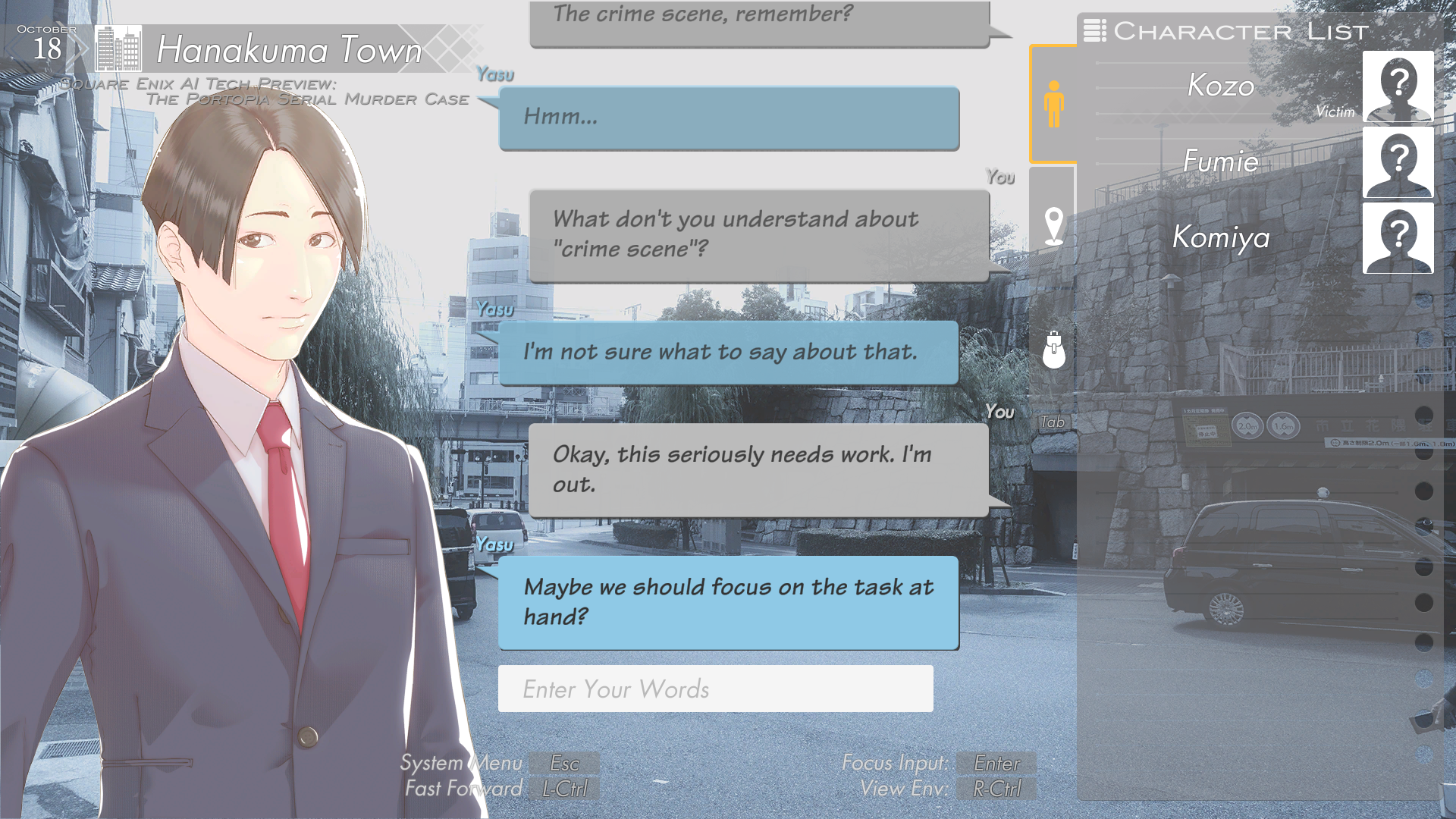
I got quite excited the other day, when Nimgimli pointed me to something Square Enix were trying out on Steam. They're calling it a "Tech Preview" and the description describes it as "a demonstration of Natural Language Processing (NLP), an AI technology".

As far as I can tell, Square have grubbed up a very old adventure game called The Portopia Serial Murder Case, originally released in 1983 (!) for a system called the NEC PC-6000 and force-fed it their proprietary AI tech to see what might happen. According to Wikipedia, the original game has suffered similar indignities in the past, having been ported to a few other long-forgotten platforms before eventually making its way into the mobile market and finally arriving on Windows and Steam as a shill for Square's "natural language processing technology."

Again according to Wikipedia, TPSMC ,as I'm going to call it to save all that typing, went down pretty well in Japan on its original release and was seen as being influential in the development of the visual novel genre. It sounds like the kind of game I'd enjoy, with its "point-and-click, murder mystery plot, open world, suspect interrogations, nonlinear gameplay, dialogue choices, and alternate endings" which, as a review in the Official XBox Magazine a few years back pointed out, were "standard for 2015, but way ahead of its time in 1983".

The Tech Preview is free to play on Steam so I thought I'd give it a try. I was somewhat surprised at the size of the download which, at more than 8GB, seemed like it would have required a government supercomputer to run in 1983, not a rinky-dink home computer. The System Requirements actually ask for 15GB though, so I guess I got off lightly.


Those requirements also contain a curious note about Speech Recognition: "Voice Input (Speech To Text) requires CUDA cores. (*1) VRAM 8GB and above required when using “Medium” in Voice Input quality settings. (*2) VRAM 16GB and above required when using “High” in Voice Input quality settings. Keyboard and/or Microphone support only." It seems to suggest you can play the game by talking to the characters rather than typing your conversations and reading their replies. 

That's something that would very much have been seen as the expected future of computing back in the 1980s, when Japanese tech giants were throwing vast amounts of money and effort behind the so-called "5th Generation", one of whose fundemental principles was to replace keyboard input with the spoken word. Much like videophones, which were a solved problem by the early '90s but which failed to attract any kind of interest from the public, speech recognition, when it was perfected, turned out to be something most people didn't want - and arguably still don't.

Still, I'd like to try it in an adventure game whose gameplay revolves around interrogation. It seems like a natural fit, especially when you throw in AI. I'm already excited for the inevitable and probably imminent integration of language processing AIs like Bard and ChatGPT with Smart Speakers and Virtual Assistants like Alexa and Siri. To see something like that in a game would be amazing.

There's only one drawback. I don't have a microphone.

Okay, technically I do have one. I actually have several, including two integrated webcam/mics that I acquired when I foolishly bought into John Smedley's lucicrous SOEmote fantasy ,of which the less said, the better. 

What? You don't remember SOEmote? Oh, what the hell...

I guess if you have a naturally gurning, cartoonish face like Dave Georgeson, maybe it would seem like a good idea, although evet then it would actually have to work...

Anyway, while I might theoretically own some mics, I don't have one to hand and even if I did, I definitely don't want to start fiddling around trying to get this game to recognize it. I mean, I might, if I thought there was the least chance of it actually working, but I've tried the text input. "Fool me once..." as they say.

About that text input. Y'know, I've played a lot of adventure games. I was already playing them when TPSMC first came out, back in the very early '80s. I used to sit there, with my first wife, in our first appartment, typing keywords and phrases into the ZXSpectrum's rubbery keyboard, hoping to see some kind of acknowledgement or recognition on the portable TV in front of us.

A decade and a half later I'd do the same thing, with Mrs Bhagpuss leaning over my shoulder and making suggestions, as we plowed our way through Broken Swords #1 and #2. Even EverQuest used a text parser before someone at SOE finally got around to adding clickable keywords.

Any - all - of those text parsers were orders of magnitude better than whatever the hell "Tech" it is that Square Enix thinks they're previewing here. And I'm not the only one making that assessment. As I write, the game or demo or whatever it's supposed to be has Steam's lowest possible rating - Very Negative - and in my opinion it's lucky to have a score as high as that.

Try some choice comments from angry reviewers:

"...the "AI" in this game is a joke. It is perhaps even worse than the text parsing of the original game, from 40 (!) years ago."

"GEEZ It's like they didn't even try...."

 "Zork (1977) had a better understanding of what your commands meant"

"Early text-based RPGs are way smarter at responses than this."

"basically it understands less inputs than the original King's Quest"

"This is a fascinating idea, but the execution is... I'm not sure it even rises to the level of "weak." It's not in evidence at all."

Aha! I think we've hit on the problem!

"Barely works. They say they removed the AI component due to safety concerns... so this doesn't even have the tech that it was supposed to be a preview of in the first place."

Well, that explains a lot. Okay, it doesn't explain how the game as it stands is literally worse than the basic, acceptable standard of games of its type from the era in which it was made, but it does answer the question I was asking myslef throughout the whole of the five (Count 'em - five!) minutes I could stick playing the blasted thing, namely "AI? What AI?"

I thought I should check if the allegation was true, so I asked Bard. Bard, being an actual generative AI, not a pretend one, was quick to give me the full story:

Hi Bard, Can you tell me if Square Enix has disabled the AI component of their tech demo for The Portopia Serial Murder Case?

Yes, Square Enix has disabled the AI component of their tech demo for The Portopia Serial Murder Case. The demo was released on April 24, 2023, and it allowed players to interact with the game world using natural language processing (NLP). However, the AI component was disabled on April 27, 2023, after players began to exploit it to generate offensive and inappropriate content.

In a statement, Square Enix said that they were "disappointed" that the AI component had been used in this way. They said that they were "committed to providing a safe and enjoyable experience for all players" and that they were "working to improve the AI component so that it can be used in a more positive way."

The disabled AI component was a major disappointment for many players who were looking forward to trying out this new technology. However, Square Enix has said that they are working to improve the AI component so that it can be used in a more positive way. It is possible that the AI component will be re-enabled in the future, but it is not clear when this will happen.

Other than Bard's curious ability to predict the future (Check the dates it's quoting - I almost missed it.) and fondness for repeating itself, that seems to be a reasonably accurate account of what happened. It's corroborated by this report at BeyondGames.biz and many others as well. 

So much for that "preview". It does invite the question "Why leave the bloody thing up with the claim the AI's still in there, then?", but since this is Square Enix we're talking about, I wouldn't expect a coherent answer.

Someone is going to get this tech hooked up and working effectively but clearly that someone is not going to be Square Enix, who seem to be about as realistic in their expectations and as technologically capable of achieving them as Smed and Smokejumper's SOE. 

And we al know what happened to them...

Saturday, February 18, 2023

The Eightfold Path

Say what you like about Square Enix but you can't say they don't keep you informed. Sometimes it seems like I get an email from them every day. Of course, it's not that often, really. It's every other day. 

I guess they have a lot to talk about. They seem to produce an astonishing quantity of games. This month alone they've told me about Final Fantasy VII, Life is Strange 2, Tomb Raider Reloaded, Dissidia Final Fantasy Opera Omnia, Paranormasight and Final Fantasy XI. Just about the only game they haven't mentioned is the one I might actually play, Final Fantasy XIV. I haven't had an email about that one since last year.

The game Square are keenest I should try right now isn't anything I've mentioned. It's the follow-up to a game I've heard a lot about but never thought of playing: Octopath Traveller. The sequel goes by the unimaginative but commercially canny title Octopath Traveller 2. It launches next week and  and they've sent me three emails about it in the last six days.

Okay, now I know what to look for, I guess that could be a tail. I thought it was a pony-tail!
As I say, I very rarely open any correspondence from Square. The most I ever do is scan the title. More often than not I don't even do that. I don't look at any emails I don't think will interest me, which is why I currently have nearly 18,000, unopened, in my Inbox. I almost never delete emails, either. You probably guessed that.

What Square were so keen to tell me is that there's a demo for Octopath Traveller 2 on Steam. As it happens, I already knew. I found out somehow, while I was looking up something for the recent Next Fest. The OT2 demo wasn't part of the event but it got a mention somewhere in despatches.

I probably still wouldn't have bothered downloading it if it hadn't been for one thing; the demo is actually a three hour limited free trial. You can make a character and play the game just as though you'd bought it, within certain restrictions, until Steam registers that you've been playing for a hundred and eighty minutes.

Make your minds up! Is it "Beastling" or "Beasting"? I know which I'd go with.


You don't have to do it all at once, either, which is just as well. Three hours is a long time. Most demos I play take less than an hour. Three hours is a whole evening. Anyway, it seemed like an offer worth checking out, so I did. 

At this point, I probably ought to explain that even though I've read quite a few blog posts about Octopath Traveller, I've never had a very clear idea what sort of game it is. People seem remarkably unclear about it when they recount their experiences. I had the sense it was some kind of turn-based card battler, maybe along the lines of Slay the Spire, not that I have much of a clue what that one's about, either. 

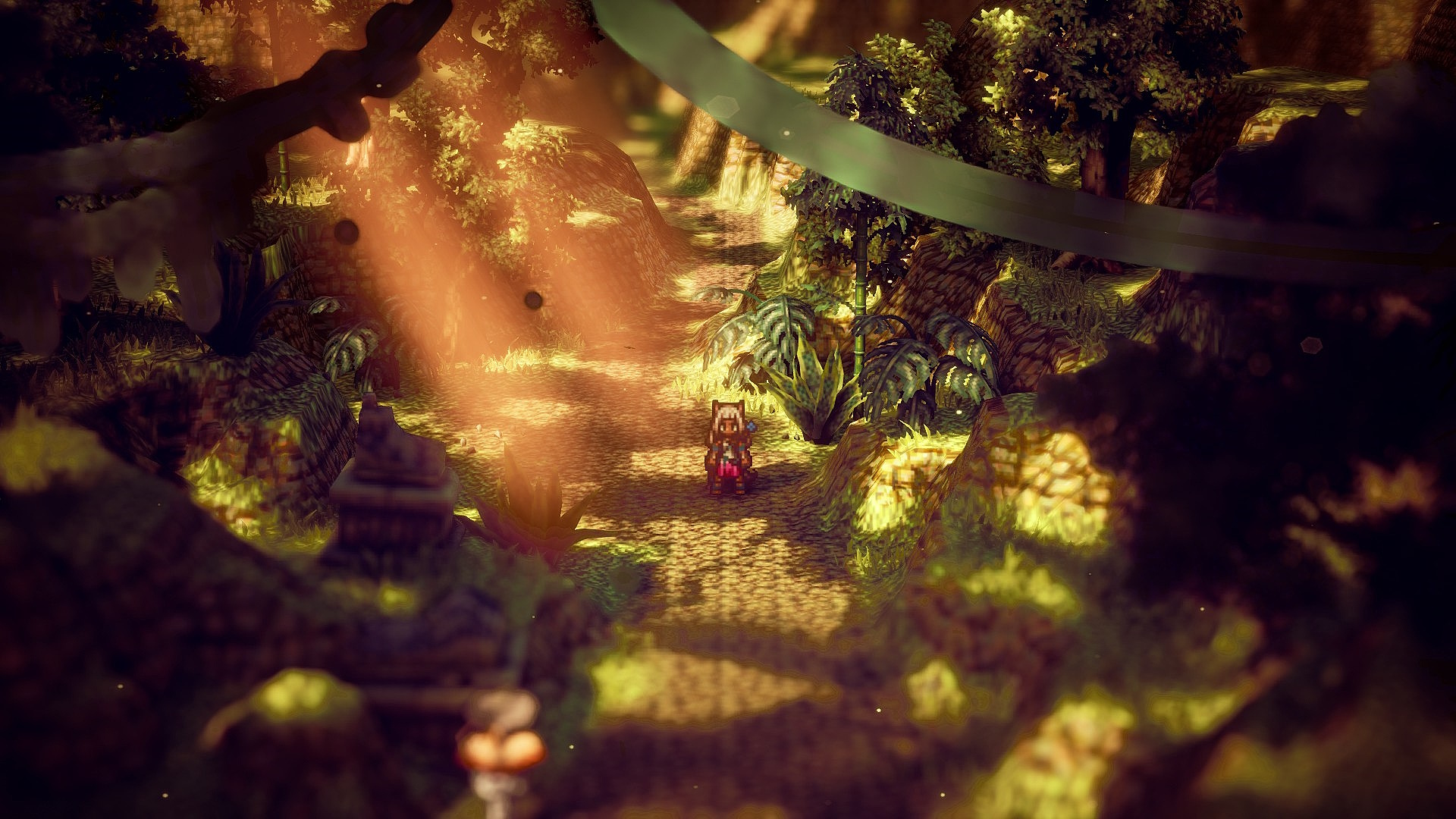
If the original is anything like the sequel, I've clearly been under a great misapprehension. About the only thing I got right was the turn-based part. Other than that, it seems to be some kind of open world, story-led RPG, done in pixel graphics. 

All we need now is a little lens-flare.

I'm not going to go into great detail about how the game looks or plays. I've played for just over two hours so far, which is hardly enough for more than a First Impressions piece, if that. What I will say, though, is that the graphics are extremely effective and evocative, the characters charming and delightful and the story well-written, well-acted and involving. On the whole I had a good time.

My big problem - and it's a huge one - is the combat. It's unnutterably tedious. I generally enjoy turn-based combat but it always has the same drawback; it takes forever. When I enjoy the mechanics, as in Wizard 101, for example, that's not much of an issue but when I find them dull beyond description, it really, really is.

I can name three very specific reasons why I didn't get on with the combat in OT2.

  1. The icons are far too small and difficult to make out.
  2. There's far too little feedback on what's happening.
  3.  The menu system is fiddly and annoying.

Literally. Stuff one of these kebabs in your face during a fight and whoosh! Full health.

There's more that I didn't like about it but those were the worst bits. Even then, I could have put up with it if it was just the battles in the storyline and there weren't so many random encounters. The whole concept of an open world becomes moot if you can't go ten paces without something challenging you to a duel.

That's why, despite enjoying the story, liking my character and wanting to know what happens next, I gave up before my three hours were at an end. I just couldn't take another pointless battle. 

I imagine I'll go back at some point to claim my final fifty minutes. I understand the structure involves eight playable characters that eventually come together to form a team (At least I think that's how it goes...) so I might give another a try. You can play any of them in the demo. 

I chose Ochette and Ochette chose Akala. He's a fox so it wasn't really much of a choice. More of a racing certainty.

I picked the Beastling, Ochette for my first run. Surprise, surprise, you might well say but I swear I didn't even know she had a tail when I picked her. I only chose her because I wanted someone who used a bow.

Just selecting a character at all was a major achievement. If there's anything in the demo that tells you you need a controller I missed it so I was flummoxed when the keyboard didn't work at all. I couldn't even use the menus. 

Fortunately, I have a controller plugged in all the time these days so I swapped to that and with a little experimentation soon got to grips with the controls. The game felt very comfortable with a gamepad after just a few minutes, which is a massive plus for someone like me, who rarely uses one.

Not so much the end as the end of the beginning.

After that everything went very smoothly. I liked the rest of the game so much, I'd be very happy to play Octopath Traveller 2 all the way to the end if only there was a version with no combat at all. I'd be more than satisfied to toddle around the neon-lit jungle paths and sail the pixel seas in search of adventure, just so long as I didn't have to fight anything.

Unfortunately, fighting seems to be the main point of it all so I'll have to give this one a miss. Shame, though. It was fun while it lasted.

Sunday, January 2, 2022

Reasons To Be Fearful. Or Cheerful. Your Choice.


For once, I'm serious when I say I don't have time to come up with a real post but I'm darned if I'm going to let that stop me. What I'm going to do is precis the two posts I would have written today, if I'd had the time. Maybe later I'll get to write them in full and maybe I won't but at least if I ever read this back I'll know what I was thinking of doing.

#1 - Square Enix Loves Money

Yeah, they do. Wilhelm was the first to point to this in his 2022 Predictions post but now everyone's talking about it. Just in case anyone hasn't seen it yet, here's a link to the full and chilling announcement from Yosuke Matsuda, President and Representative Director of SQUARE ENIX HOLDINGS CO., LTD. (His capitalization, not mine.) It reads like the set-up for a dystopian SF novel. Jack Womack would be proud to have thought of it.

I'll just add that I'm becoming less and less certain that the prevailing "It'll never happen" view is sound. Oh, none of the "good" things will happen, you can bet on that. We won't get rich doing our dailies or trip gaily from FFXIV to World of Warcraft to Guild Wars 2 all while playing the same character and waving the same sword, but whether online games or even the worldwide web will still look remotely like they do now in ten years' time, I'm not so sure. And the idea that "governments won't allow it to happen" seems laughably naive. Governments are generally a decade and change behind any technological or cultural shift. They won't be in a position to do much about it until it's too late, by which time we'll be onto the next post-capitalist nightmare. 


 #2 - New Music is the Best Music

I follow a blog by Simon Reynolds, called blissblog (or possibly blissout, as it says in the Blogspot address). I'm always on the verge of unfollowing it because I rarely read it and when I do I even more rarely like any of the music or agree with any of the opinions expressed. 

Yesterday, however, Simon linked to another blog, this time by his son, Kieran Press-Reynolds. Kieran has a list of his top 20 songs of 2022, plus some that nearly made the cut. I started listening to them out of idle curiosity and ended up spending over an hour there, first listening to some of his choices and then following up the YouTube links they generated. 


I didn't like everything I heard and I only dipped in to the stuff that caught my eye on a first glance but the quality overall was staggeringly high. I'll be going back to check out the rest of Kieran's faves and to explore the areas, styles and performers I take a shine to in a great deal more depth. No doubt, some of the fruits of that labor will end up here, in due course. You have been warned.

Thanks to Kieran for doing the work and to his father for sending me there. Also, Kieran writes beautifully, which is a bonus.

I said I was going to keep this short and I already haven't, really. Better stop while I still have enough time left to do those dailies. Need to keep in practice for when all our games become virtual sweat shops. I imagine there will be quotas.

Tuesday, November 9, 2021

Welcome To Your Future - NFTs, Play To Earn And Robot Dogs.


I can't turn around right now for news items about frickin' cryptocurrencies, blockchain and NFTs. What I know about all of them together could comfortably be etched onto the eyeball of a gnat with an industrial mining laser, which is, conicidentally, one of the three standard means of production for NFTs. 

Well, it might as well be. Who knows how the damn things work? I read Tipa's recents posts on NFTs with some interest, not least because so far she's been one of the very few people I've seen who've been able both to explain the concepts behind the processes and the reasons why anyone might be persuaded to care about them. 

I also read Rob Fahey's excellent article at Gamesindustry.biz, linked yesterday by Wilhelm in a post about EVE, whose comment thread I hijacked on the back of it. The article, which I recommend for anyone who, like me, couldn't quite figure out what all this had to do with the future of video-gaming, has the classy title "Baseless NFT hype hits a crescendo - but play-to-earn is worth watching.", which just about sums it up.

It would be nice to pretend we can all just sit back, munch popcorn and enjoy the show but unfortunately I don't think that's going to be an option for much longer. Sure, we're none of us going to get sucked into the Ponzi schemes, wild punts and outright scams that are currently hyping up the media from niche to mainstream but neither are we going to be able to pretend big changes won't be coming to the games we play. Big changes that will affect us whether we choose to participate or not.  

As a growing number of formerly infatuated, not to say assimilated fans seem belatedly to have realized, video game companies are not our friends. They never were. 

It's nice to pretend otherwise, of course. I do it all the time. We play favorites and profess brand loyalty and that's fine so long as everyone knows it's all just make-believe. Any game company would sell your loyalty for a dime on the dollar if they thought they'd get away with it so it's probably best not to give it them in the first place. 

These past couple of years we've seen Blizzard, for so long one of the industry's most loved and respected developers, locked in a flaming death spiral that just seems to get worse and worse. If it can happen to them, it can happen to anyone.

No-one, I'm sure, is the least surprised to hear the widely-reviled Electronic Arts making sweeping statements about embracing NFTs and blockchain as "the future of our industry". Ubisoft aren't many peoples' idea of a fuzzy, warm BFF either, so it's not too much of a shock to learn they also rate these new, invasive technologies as crucial to the development of video games.

It's not just the usual suspects, either. It's the supposed good guys. How about Discord, everyone's go-to for teamwork, chatter and all-round fun times? As the title and strapline of the NME news report I just read a couple of hours ago put it, "Discord community boycotts platform over “disappointing” crypto integration. Users are cancelling their Discord Nitro subscriptions to protest potential NFT and cryptocurrency integration."

What is Discord doing that's got Reddit all riled up? (Admittedly not a difficult thing to do.) Testing integration of the platform with cryptocurrency and blockchain functionality, that's what. And surveying users on their familiarity with NFTs. Doing due dilligence and getting ready for the future, in other words. 

Yeah, but that's just Discord. We were already beginning to fall out of love with them anyway. 

Okay, sure. That's true. How about Square Enix, then? Everyone loves SE, right? We can trust the company that gave us the game everyone says World of Warcraft needs to learn humility and compassion from, surely?

Can we, though? Can we? Here's the NME again: "Square Enix looks to be going all in on NFT-based games." And why wouldn't they? As the article explains, the company's first experiment with the concept was a sell-out success.  

Square aren't messing about, either. Following that proof of concept they intend to "transition to [a] full commercialisation phase" that will "focus on blockchain games premised on token economics as a form of decentralised content.

The NME article links to an official SE report, the Financial Results Briefing Session Six‐Month Period Ended September 30, 2021. I think it's a powerpoint presentation or something along those lines because it looks like a bunch of slides. I'd reproduce some of them here only I'm a little unsure of the copyright situation and, y'know, Square.

I would strongly suggest clicking through the link and reading the thing anyway. It only takes a few minutes. If anything, I'd say the NME article underplays the intensity of Square's burgeoning commitment to bringing all things NFT and blockchain into our lives. We're going to love it, apparently, because we've already demonstrated with our wallets that it's what we want. 

And who knows? Maybe it is. I've lived long enough to be able to give you a top ten of technologies I thought I neither needed nor wanted but ended up not knowing how I could have lived without. Perhaps the self-satisfied glow of being able to "point" to an intangible asset that I don't really own but for which I paid money is going to keep me warm at night although I remain to be convinced.

More likely, I suspect, we're all going to get to share in a degraded, not to say degrading experience as "content" most of us neither want nor understand gets awkwardly bolted on to the games we already play and built in by default to those we're going to play next. 

Yes, we'll probably be able to opt out of spending money on any of this but whether we'll be able to opt out of the gameplay implications I'm not so sure. I don't know about anyone else but the up-and-coming industry buzzword "Play to Earn" does not fill with me with joy and delight. I play to play, y'know and I'd kind of like to keep it that way, even if that does mean leaving (imaginary) money on the (virtual) table.

Ah, but that's the key, isn't it? The money's not imiginary, not any more. It would be bad enough if all this was going to happen inside the games but there's every sign the damage is going to spread to our real lives as well. Proving I do indeed get all my news from the same silo, here's NME one last time: "NFT owners in the US to start paying taxes on their investments".

Buried super-deep in the guts of the apparently unrelated H.R.3684 - Infrastructure Investment and Jobs Act you'll find "Section 80603, “Information reporting for brokers and digital assets.” Yes, I did go digging for it. It was not fun but I am not so besotted with the NME as to take their financial reportage at face value. Here's a gloss on what it means, also not a light read. 

To save you the trouble, the two key sentences seem to be a definition "The Notice defines convertible virtual currency as virtual currency which has an equivalent value in real currency or acts as a substitute for real currency" and a statement "A payment made using virtual currency is subject to information reporting to the same extent as any other payment made in property." Seems clear enough. 

Once President Biden signs off on the bill those regulations will come into force for tax returns due to be filed after December 31, 2023. They're not kidding about that "Play to Earn" thing, are they? Just wait until the tax inspector takes a look at the API for the dollar value of crap you threw onto your bank mules. That's literally a thing you can do in Guild Wars 2 already, you know, which is why I haven't given the game those permissions.

Maybe this is all just one of those periodic media flaps we'll laugh about in years to come, like the Y2K bug or the Sinclair C5. Or maybe this is the leading edge of the dark stormfront heralding the coming of the Age of the Megacorps. 

I know! Let's have a funny video of a cute robot dog called Spot. That'll cheer us up.


That's not scary at all, is it? And I'm sure you couldn't put a gun on the front of it. I mean, corporations and governments always have our best interests at heart, right? They'd never say one thing and do another. If they say they're going to help us have fun, make money and stay safe, I'm sure that's exactly what's going to happen. Everything's going to be fine.

And I didn't even mention the Metaverse!

Saturday, November 2, 2019

Around And Around

The reveal of Blizzard's plans for a sequel of sorts to Overwatch clarified some thoughts I've been having of late concerning the direction in which MMORPGs appear to be headed. Indeed, given that Overwatch isn't even an MMO as such, perhaps it's a vector that applies to gaming in general.

Once upon a time video games were standalone entities. They came in boxes that you went to a store to buy. You played them, you finished them (or gave up trying) then you put them on the shelf (or sold them) and moved on to the next.

If a company managed to come up with a hit, the usual way to double down on that success was to produce a sequel. There would usually be some thematic continuity but the new game would once again stand or fall on its own merits.

The lines began to blur when sequels started to allow the importing of saved data from their predecessors. I'm no video-gaming historian but even I have vague memories of being offered the option to transfer some aspect of my previous incarnation into a new game.

When games began to make their slow and tentative move online those hard demarcations began to blur still further. EverQuest only ran for a year as a pure core game before receiving its first "expansion". From then on I came to expect that any online game I played would grow like an unruly building, adding new rooms and wings to the original structure at regular intervals until its sprawl rivalled Gormenghast.

After a while, though, it seemed that game developers weren't satisfied with just expanding their virtual worlds and their profit margins along with them. They wanted to clone their successes just like their predecessors had done in the good old pre-internet days, something their offline competitors had never stopped doing.

Things didn't go entirely to plan. Some proposed sequels to MMORPGs were cancelled before they saw the shelves of any store and the ones that did make it struggled to match, far less eclipse their progenitors.

A few - a very few - managed to establish a separate identity and truck along profitably if unspectacularly. Lineage 2 and EverQuest II spring to mind. Even the "success" stories, though, were limited in what they were able to achieve. EverQuest is very likely still more profitable than EQII and Lineage is well ahead of its first sequel, albeit not the mobile version.

Whatever appetite developers might have had for creating entirely separate sequels seems to have dissipated in the face of these diminishing returns. That's perhaps surprising in that the last two attempts, ArenaNet with Guild Wars 2 and Square Enix with Final Fantasy XIV, have been relatively successful.

Even so, Square had to scrap and remake their follow-up to Final Fantasy XI before they could begin to recoup the cost of development, something almost no other developer would have done. Guild Wars 2, meanwhile, despite its initial success, has been drifting slowly downwards ever since. The linked NCSoft sales chart above has GW2 running barely ahead of Aion and well behind Blade and Soul. Not a strong predictor of long term success for anyone considering making a sequel to an MMORPG.

Significantly, both Square and ANet chose to mothball their first generation MMOs when they put their weight behind sequels. They recognized the potential split in their own customer base should active development continue on the older titles so they chose to close that door lest it slam in their faces, leaving the new baby locked out in the cold.

There has been talk of a World of Warcraft 2 for years but never the least hint that Blizzard considered it worth the time and effort of discussing, let alone developing. Even when they were working behind the scenes on a second MMORPG, Titan, it was something entirely separate to WoW.

That project, repurposed, became Overwatch, which now, ironically is getting a sequel. Of a sort. Those lines are blurring once again.

Blizzard have become experts at that. World of Warcraft, a game once derided for its cartoonish graphics, is now releasing promotional shots of its upcoming expansion that receive fulsome compliments. Hardly surprising since they've been upgrading and updating the game's graphics continually throughout its fifteen years.

Blizzard also, famously or infamously, re-writes the entire gameplay of WoW with every expansion. Rather than launch WoW 2 and split the audience they re-invent WoW every couple of years instead. How ironic, then, that they should find themsleves curating WoW Classic, thereby placing WoW Retail in the invidious position of being the sequel to a retroactively revived original. No wonder they resisted it for so long but in the end it's always the money that talks.


Meanwhile, with varying degrees of success, major players like ArenaNet and Zenimax/Bethesda find ways to reinvent their own MMORPGs so as to keep them relevant and fresh to both old and new players alike. Why go to the trouble of starting over when you can roll along with a never-ending sequence of micro-starts instead?

Or at least that seems to be the theory. It's a messy one at best. MMORPGs these days are a rat's nest of free updates, chargeable DLC, cash shop content and full expansions. Even the word "expansion" has morphed into meaninglessness, with some games using the term for every monthly update regardless of its gravitas or impact.

The picture becomes even less clear when you factor in those developers who choose neither to create a sequel nor to expand and update the games they already have, but to split titles like sickly amoebae, spawning imperfect copies of themselves. Funcom probably started the trend with Secret World Legends.

Gamigo, having picked up ArcheAge in Trion's fire sale, followed suit with ArcheAge Unchained. This is clever marketing. Why make a whole new game when you can just re-jig and remarket an old one and sell it to the same people all over again?  Where Blizzard would make these changes in the primary property, the new idea is to keep that running as-is and put your revamped version up for sale as-new.

It's genius, really. Especially when, like Gamigo, you can convince people to pay either a box price or
a subscription for a re-tooled version of something they used to be able to get for free. It also saves you the trouble of going back later to come up with a "Classic" version to feed that particular niche. All development goes on permanent hiatus in the original so there it sits, waiting to be re-promoted as "Classic" at some future date, should market indicators suggest doing so might turn a profit.

Overwatch 2 looks very interesting. I've never played the competetive PvP version but I've read a fair amount about it and, like many, I've thought it would have made for a fun MMO. The proposed sequel isn't that but it adds all the narrative and PvE content the original eschewed.

That will bring in a whole new audience from Blizzard's PvE-centric playerbase but the real brilliance of the scheme is the way the two games handshake. Overwatch 2 plans on "carrying forward all of the original game’s heroes, maps, and modes—as well as existing Overwatch players’ accomplishments and loot collections". Meanwhile, the new game will enjoy "character progression ... only for the PvE side" while "PvP players will have a level playing field without any of these potentially match-breaking abilities."

Is that a sequel, an expansion or something strange and new altogether? I guess we'll just have to wait and see but if it works count on seeing other developers tagging along behind. It's certainly a step up from all those Battle Royale spin-offs, at least.

Everwake is optimistic about the idea of so-called "Live Services", saying "A low monthly fee that acts as a content discovery vehicle is something that works for me." He's still a little wary of the implications, though, and so should we all be.

As we should already have known and as we've been most rudely reminded by the recent Blizzard brouhaha, big companies are not our friends. None of the changes and developments they make are designed to make things easier or more convenient for us - they are wholly and solely intended to increase revenue.

If game companies can successfully lock you into their ecosystem and then repackage and re-sell you the same game over and over and over again, don't think they won't. After all, it's only the same system all the other media empires have been perfecting for years.
Wider Two Column Modification courtesy of The Blogger Guide