Showing posts with label immersion. Show all posts

Wednesday, September 8, 2021

A Very Short Introduction To The Metaphysics Of Immersion


Wilhelm
has been running a series on immersion in video games, looking in detail at what makes specific game immersive for him. So far he's covered EverQuest, Lord of the Rings Online and EVE Online

In the bullet point list of immersive elements in each game, one common factor recurs: "Sense of place". Or "Feeling of place" I think those are the same thing.

I was thinking about that as I was playing Bless Unleashed the other day. There's that mini-game I mentioned before, where chest icons show on your map and you can go find the actual chests and open them to get gold, salvage mats and, most importantly, bag pieces that you hand in, four at a time, to an NPC, who then adds one more slot to your inventory.

You could write a whole thesis on the paradoxes of immersion based solely on that mechanic. It's a seemingly small thing but it adds an almost metaphysical tactility to the game in a way that should feel very familiar to orienteers or geocachers.

I imagine everyone's familiar with the cultural trope "The map is not the territory". It very much applies here but in a virtual world, accessed remotely through a combination of physical and digital processes, extra levels of metatextual nuance apply. 


Neither map nor land has physical existence but your keyboard or controller does. They can be touched but your character, who's in the virtual world, can't touch them, just as you can't touch your character, who is not you and yet acts as you would or at least as you intend. 

Your character can't touch the map, which you can see but which there's no apparent evidence your character can, although in some games I've played the character can be seen unrolling and looking at the map inside the game. 

Your character can touch the chests except, naturally, as a non-physical entity, your character cannot "touch" anything. Inside the game, not "naturally", because this is not always the case, but it is the case in Bless Unleashed, they can touch many things; many things have "collision" which means they cannot just be walked through, although other things, which look as though they could not be walked through, can. 

The chests can be touched but they can't be opened except as you, the player, touches the keyboard, whereupon the chests open and can be seen to open and your character can be seen to open them or to make movements that imply an opening action even though the character's hands and the lock on the chest don't necessarily interact or can't be seen to interact. 

The chests, when found, may be standing in the open, plainly visible, sometimes next to NPCs, the notional residents of the gameworld, deemed to have integrity of action and viability of purpose when it comes to scripted interactions and yet missing any and all necessary reaction to independent activity carried out by your character under your instruction. 

Your character can open the chest and take the contents in full view of the ostensible owner or custodian of the chest without any comeback, criticism or complaint. Unless, of course, the chest is near some individual whose aggression is mandated by your character's mere presence, in which case conflict will occur, albeit conflict unrelated to your character's actions, intended or otherwise, regarding the chest or, indeed, anything else.

As you progress deeper into the world of the game the chests become less obvious in that world, more hidden. Their presence on the map becomes an indicator that must be construed. Frequently the chests are obscured by shrubs or foliage, which moves as your character pushes into it, just as plants would if you, the player, pushed past them.

At this happens you may notice a difference between your, the player's, viewpoint and that of your character. You may find your view obscured by branches that are self-evidently out of your character's eyeline. As you move the mouse and press the keys to swing the "camera" (there is no camera although in other games I've played there are sometimes, in fact, cameras that can be seen and moved and used, as cameras, inside the game), the screen that acts a window into this other world (Does it, though?) fills with leaves. 

You turn and twist, trying to find a gap to peer through to find the chest but you don't need to see the chest. Your character can see the chest or sense it, somehow, or so it would seem, because when they stand near enough the letter "F" appears on that screen, a letter, we can only assume, although cannot know, your character cannot see. When you, the player, press the corresponding key on your keyboard (or, no doubt, some icon on the controller, if that's how you're interfacing with the game) your character will open the chest and take the contents.

We won't go into what happens to the contents. That's another layer of reality, a layer too far for this short introduction.

Let's get back to the map. Remember the icon that showed you where the chest would be found? It's gone. Did you remove it? No, you did not. Did your character? No. We established your character doesn't appear to see the map, although since, when the map is open, you cannot see your character, you cannot say with any certainty whether that is true.

However it happened, it happened. The icon is gone. 

Now look at the chest in the world.

You can't. It's gone, too. 

The map is the territory, after all.

But the game world is clearly not our world. If, as is the case with some hand-drawn, published maps I sell in the bookshop where I work, a map has an icon for a sign-post that does, physically, stand in the territory the map represents, and if some map-using prankster, following that map, finds that sign-post in the physical world and pulls it out of the ground and hides it in a hedge (not that I have known people who would do that but I know it has been done) then the icon for the now no longer standing sign will not vanish from the map. The signifier and the signified have diverged. 

In the game world the signifier and the signified converge. At least in this instance. (Not that this
happens in an "instance". Let's not get into instances any more than we got into inventories before.)


From all of this you might well expect immersion, the sensation of being engaged by and taken inside a supposed reality other than your objective own, would fail. And yet this is one of the more immersive systems I have experienced in recent times.

All of these contradictions (and there are many more I could have brought) are somehow stitched together into a patchwork of convenience that covers every gap and tear. How it all works beats the hell out of me but work it does.

There have been times when I've been looking for one of those chests, trying to figure out how I can be standing right on top of the damn icon (I'm not standing on the icon, my character is, and I am not my character, only I am, and my character is not standing on the icon, the icon is on the map and my character is holding the map, only my character is not holding the map or if they are I can't see them holding it...) and still not be able to see the blasted chest (because, as it will turn out, the chest is on a bridge over my head or in a crevice under my feet or stuck halfway up a tree trunk or embedded in a rock...)

At times like that, sometimes, I am so lost in what I see, what my character sees, what the map shows, what my screen shows, there's no space left for any other thought. There's only the map, the chest, my character and me.

And that's immersion. 

Oh, by the way, I lied about the map. The chest icon never appears on the map. Only on the "mini-map", the circle that shows on the heads-up display on your screen. That changes everything, or maybe it doesn't.

We could go there, if you want. Probably best not.

Wednesday, February 26, 2020

A Glimpse Of The Past

I'll try to keep this short. Shouldn't be hard. I don't have a lot to say.

Past Fate is "an open world MMORPG game where the players freedom is the key element" or so the website tells us. Makes it sound like a sandbox, which it definitely isn't.

According to Massively:OP the game has the dubious distinction of having failed spectacularly to fund on Kickstarter, racking up just $1000 in pledges against an exceptionally low bar of $15 grand. Apparently undeterred, the Finnish studio, Icy North Games, is carrying on and the game went into Open Alpha this week.

One of the larger villages I found. All of them looked much alike.

Well, "Open Alpha" is what they're calling it. It's a single week, showcasing only one of the five classes, Warrior, (the others being Necromancer, Mage, Priest and Pirate) a level cap of 10 and a couple of the early areas complete with quests and basic crafting. 

Full details are here on the download page. The server should be up 24/7 for a few more days if anyone's interested in taking a look for themselves. 

It's probably not worth making a special effort even if it's the sort of thing you think you might like since there's a tentative plan to run an extended open alpha when and if there's a second Kickstarter. Project: Gorgon did that and it worked for them - eventually. They did have to take three bites at the Kickstarter cherry but they got there in the end.

Here I am, coming into the harbor of the very same village by way of a boat trip from the one where I logged in. Not sure what I expected to find but what I saw when I got there  looked pretty much like what I was looking at when I left.
The main reason I downloaded it was that from the screenshots it looked as though Past Fate might be a traditional tab target and hotbar game and I'm always on the lookout for a new one of those. Sadly, from my point of view, it's not. It's the now-standard center-screen targetting, mouse-combat action set-up as seen in Black Desert and many others.

There's not an enormous amount to see in the limited alpha. You can't make a personalized character since you can only be a human warrior and they all look exactly the same. (You do get to choose between male and female but I couldn't see a way to look at my character from the front so it's a bit of a moot point). Animations are clearly placeholders so there's not much to be gleaned about what your character might one day look like.

Scenery is pleasant if generic. I ran around a lot and it looked much the same everywhere - a lot of woodland, a few rocky hills, some water. Some of the forest looked wild, some like parkland. 

One of the more manicured parts of the forest. Also, that shot does the running animation no end of favors.
I came across several villages. All the houses were wood or wood and stone. They looked passably authentic for the environment although none you can enter have doors, something that always makes immersion harder for me. It's clearly a cold, northern land - why would they let all the heat escape from the places where they live?

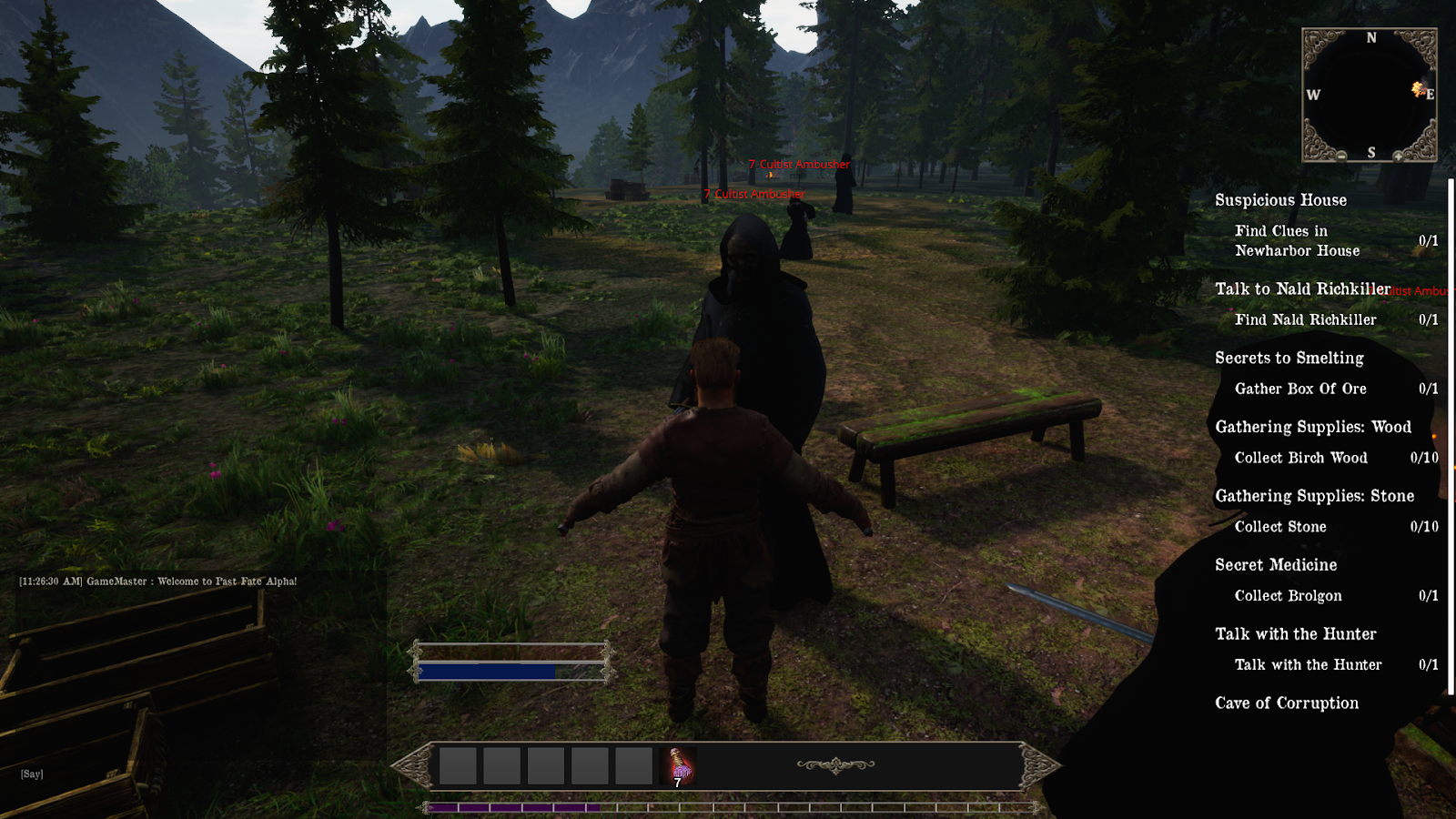
There are quite a lot of quests as can be seen in the screenshots, since I couldn't find a way to switch the UI off - but then I didn't look very hard. I also didn't try to do any of the quests after I'd hoovered them up and for a reason I found quite surprising: having quests seemed out of kilter with the look and feel of the game.

The quests are very plainly typical MMORPG quests. Which is fair enough. As I said at the top, Past Fate is not a sandbox. It's also not a survival MMO and makes no claim to being one. But to me that's what it looks like. 

Not sure how standing around in a field in plain sight counts as "ambushing" but I suppose they know their business. Also, I see my health bar is empty. Maybe that's how I died...
Everything about it, from the very dark, ill-lit, sub-arctic setting to the tattered leather and hand-axe starting gear to the UI and controls just screams "survival" to me, not "theme park". That's my problem, I guess, but it certainly put me off buckling down and getting on with my designated questing. 

It did also make me wonder how well more traditional PvE content like this will integrate into Amazon's New World. That was an environment I found to be very immersive indeed. I'm not sure my immersion is going to be enhanced by a lot of NPCs wearing punctuation for hats.

Also, in a traditional theme park MMORPG starting area there would be plenty of weak mobs to kill but for Past Fate's alpha they seemed to be on smoko. It took me a lot of running and a short ocean voyage to find any and when I did they were Level Seven (I was still Level 1, as far as I could tell, not having done anything at all other than run about and take screen shots).

That house has doors. I take that to mean you can't go inside.

I attacked one with my trusty starter hatchet, mostly so I could see how Past Fate handles death, but the spooky black robed cultist just stood there and let me kill him. He dropped a few things including a better axe so I picked that up and killed one of his friends with it.

At this point I noticed I had taken some damage, albeit very little, so I guess the black monks were fighting back even if I couldn't see them moving. I was still at 90% health when I attacked the third, at which point the game twitched and I found myself back at the dock in the original starting area. 

I wasn't sure if I'd died and respawned and I wasn't sufficiently interested to find out. I exited the game and came here to write about it instead. 

I'm starting to formulate a theory about quasi-realistic "medieaval" graphics and questing. It would go some way to explaining why certain MMORPGs just don't seem

For an early alpha build I've seen plenty worse. It's playable. It didn't grab me enough to make me want to push further and see what the crafting was like or to try and "Discover the story behind Count Feros Blackfang to prepare yourself for Blackfang Keep in Alpha Test #2" but it didn't put me off having another look to see how things are coming along in a few months' time.

There will be another limited scope alpha, it seems, and maybe an extended suck-it-and-see period if there's a second Kickstarter. I'll leave Past Fate installed and take another look when any of that happens. Can't see it ever being my sort of game but it's not entirely without potential.


Sunday, September 1, 2019

A Change In The Weather: WoW Classic

When it rains itn Loch Modan, boy, does it rain! Following Friday's post, which Kaylriene followed up today, I was trying to take some comparison shots with the graphics turned up to the max but the weather wasn't having any of it.

I love weather in MMORPGs. It can make a huge difference, not just to the feel of things but also to the gameplay. When I first played EverQuest in late 1999, rain closed down the field of view to such an extent it was dangerous to carry on roaming. It was imperative that you be able to see potential threats before they came into aggro range and in a rainstorm you couldn't.

If it happened to come on to rain at night, forget it. Night-time in EQ was difficult enough under moonlight but once the cloud cover filled in and the rain began you might as well just find the nearest shelter and wait it out.

Not that being indoors meant you were safe. I once spent the entire game night huddling in a hut in West Commonlands, only to be attacked through the walls by something I never saw. I managed to kill it but it wasn't until daylight that I found I'd been fighting a bear. It was dead, slumped against the stone wall, through which it had somehow managed to claw and bite me.

I guess that outfit has a certain practicality in conditions like this. Those pants are going to rust, though.

In retrospect, the game must have told me in chat what I was fighting. EQ records every last detail of gameplay in the chat log. I was so in the moment that I never even glanced at it. It was immersion of the deepest order.

By the time Kunark arrived, with its heavy jungles that already limited visibilty to a few yards, rain spelled almost certain death in some zones. It was fine on the flat plains of Lake of Ill Omen, but once you zoned into neighboring Firiona Vie you were spider bait for the hideous Drachnids that lurked in the sodden foliage. I used to wait at the zone line until the rain stopped, even if it took twenty minutes. A death would take far longer than to recoup.

Over the years a lot of that difficulty got smoothed over, even as the visuals improved by orders of magnitude. Bad weather became something to appreciate aesthetically rather than react to with frustration or fear. Final Fantasy XIV has some truly gorgeous weather effects, particularly the way wind and sand interact in Thanalan. Thunderstorms in Elder Scrolls Online are so spectacular I once spent most of a session trying to get a screenshot that did them justice.

Bear! Where the hell are we? Where the hell are you?
WoW Classic sets a solid balance between appearance and reality. The rain didn't really inconvenience me yesterday, let alone discourage me from adventuring around the Loch, but doing so felt very different from the day before. 

When the weather was fine I'd been stopping every few minutes to take screenshots of the slowly setting sun and gosh-wow over the amazing rose-petal clouds. Now I was hunkering down, pushing on with the task at hand, getting things done despite the inclement weather, just as a true dwarf should, rather than wasting time lollygagging at the pretty view like some species of elf.

It was daytime when the storm set in. I'm not sure how much more inconvenient it would be in the dark. I'm also not all that likely to find out. WoW has a very unusual day/night cycle, one I'm not sure I've seen used anywhere else in the genre.

I love the smell of wet fur in the norning.

In most  MMORPGs day and night have specific lengths. Day is usually considerably longer than night and the whole shebang rolls round in an hour or two. In WoW a day lasts as long as it does in real life. So does night.

It means that if you play on your closest geographical server cluster - EU in my case -  and you start playing at 8am to finish twelve hours later (not that 'Im doing that...yet) you'll play in daylight the entire time. I'm currently seeing maybe a couple of hours of night, at most, before I log out around 10pm.

On the other hand, if you play on a US server, as I did on one of my free trial accounts, you would barely see daylight at all. Perhaps the soft region lock worked in my favor after all.

Now that's what I call a hunter's moon. If only this was a PvP server...

That said, night, like weather, is more about immersion and atmosphere in WoW Classic than it is about inconvenience. I was in Westfall after darkeness fell last night and I was able to roam and quest without any difficulty. Well, without any difficulty caused by the failing light, at least. The hordes of players made finding anything to kill a bit of challenge. These things are much more civilized in the dwarf lands.

The corrupted farmland of Westfall may not have the rugged drama of Loch Modan but the moon coming up over the hills towards the sea was spectacular. There were players silhouetted against the huge orb as though they were auditioning for the poster for E.T.  If this was WoW Live, someone probably would have flown past on a bike.

It looked positively ethereal. As Kaylriene so rightly says, "It doesn’t look realistic because it doesn’t need to – it is a fantasy game creating a fantasy world".

My beard needed a wash anyway. Been a few months.

And it's also a game designed, back in the early 2000s, to be less alarming, less frustrating, more welcoming than its predecessors. The balance Blizzard struck between challenge and difficulty, between inclusion and exclusion, between skill and enthusiasm, worked then and still works now.

By dint of top notch art design and world-building, coupled with a desire to render the gameplay the designers themselves loved more readily accessible to a wider audience, World of Warcraft broke down the walls of a niche genre and opened it out to the world, many millions of whom grabbed it with both hands.

No-one knows why WoW became such an unexpected success. Many have tried to emulate or recreate the magic and all have failed. Evidence suggests Blizzard had no more idea how they bottled lightning than anyone else. They veered away from the formula that had worked so well and the whole genre trailed after them. The rest of the world promptly looked the other way and the walls of the niche stood themselves back up.

And finally it ends. Now all  I need is an ale or three to wash away the taste of all this water.


We are, as they say, where we are, but nothing says we have to stay there. I never played Vanilla WoW so, for me, the emotional impact of Classic is both limited and filtered through a lens formed by my prior and far more formative experiences in EverQuest. Everything in Classic seems both harder (compared with almost any current MMORPG) and easier (compared with EQ circa 1999-2006). It's impossible at this stage to predict how big Classic will get or how long its current boom will last but I tend to agree with SynCaine, when he says

"Classic isn’t just a chance for non-Retail players to enjoy WoW again; its also a live demonstration of all the ways Retail went wrong with WotLK and beyond, as well as the rest of the genre when it copied that version of WoW."
If Classic does continue to be both a popular and a commercial success for some time to come, it could pose problems for Blizzard at corporate level. As someone said (and I have to paraphrase this because I can't remember where I read it or who to credit) Blizzard won't want to have to answer questions at an earnings call about why they wasted ten years going in the wrong direction when they already had the most profitable gameplay in the genre nailed down.

It's obviously not that simple and I don't believe Classic will outstrip WoW Live but there's a seed of truth in there, somewhere. I feel we're at a turning point for the genre, or we could be. If nothing else, Classic's overwhelmingly positive reception must surely give energy and confidence to developers looking to make more complex, nuanced, wordlike MMORPGs like Pantheon or Project: Gorgon.

Perhaps we'll even see a new cycle of Classic clones. That could be... interesting.

Tuesday, April 2, 2019

There Is No Mystery Left: EverQuest

Pete from Dragonchasers posted yesterday about his preferences when playing various kinds of video games on console or PCs. Among the differences he mentioned that shiboleth of gaming, immersion:

"I find that playing on console ... There are fewer distractions and I tend to play for longer sessions which also helps with immersion...

On the PC I’m constantly distracting myself with FOMO around Twitter or Discord. I run with 2 monitors and always have social media up on monitor two and constantly scan it. Because of this I just don’t “sink in” to a game quite as much; my attention is always divided."

This triggered me. I got a flash memory of playing EverQuest in the distant past. Shivers.

For many, EQ was the very definition of "immersion", a true virtual world, where people set up home, lived their lives. That scared people.

These days we hear very little about the supposed addictive nature of the hobby but back then MMORPGs were frequently cited as potential mental health nightmares. In the early 2000s, one of EverQuest's most widely-used nicknames was EverCrack, a reference to the infamously addictive and soul-destroying cocaine variant that was by far the most demonized drug of its day.

I have no extant screenshots of EQ before about 2004. This looks likes a very early version of the moveable, windowed UI.
The mere fact that I felt I might need to gloss "crack" when mentioning it 2019 is an indication how quickly these things change. I listened to a very interesting item on BBC Radio Four last week that asked the question "why is crack cocaine rarely mentioned in the news these days?" to which the answer appeared to be "because the crack epidemic went away".

And why did the drug that the media spent so much time and energy warning us about not turn out to be the apocalyptic scourge they predicted? Luckily the program had an answer: apparently all that endless, hyperbolic publicity gave the drug such a bad name it actually did terrify people to the point that the curious wouldn't touch it, demand dropped, tastes moved on (or back, in many cases, to regular cocaine). The juicy crack stories dried up and, by and large, everyone forgot about it.

For a while. As anyone who's been around for longer than a couple of decades soon begins to realize, these things are cyclical. If you google "trends in crack cocaine news stories" you'll find that, as reported, ironically by the BBC, crack is back.

As in drugs, so in music, movies and gaming. What was old is new again. What goes around comes around and like that.

Fortnite, of course, is the new EverCrack. Or it was last year. Are people still worried about Fortnite or are we on to some new demon already? The roundabout keeps spinning faster and faster. It's hard to keep up.

And this appears to be a slightly later, cleaner version. Actually, this is better than the UI I use now...

Getting back to EverQuest, what Pete's comments made me think of wasn't so much the addictive rush of early EQ as its sheer purity. He's absolutely right about the modern approach to MMORPG gaming on PC. Compared to the original experience, what we enjoy today is adulterated, fractured, incomplete.

One of the reasons frequently cited for the decline of the genre is the contemperaneous rise of social media. It's become a truism to assert that turn-of-the-century MMORPGs were the social media of their day. For many hundreds of thousands - millions - of people, playing an online game provided their first and for a while their only experience of talking in real time to friends and strangers around the world.

This is entirely true. What's less well-reported, I think, is the focus the primitive technology of the late 20th and very early 21st centuries brought to the mix. In those increasingly difficult to remember days we tended to do one thing at a time. Well, perhaps not one. Fewer, though. Certainly fewer.

If you played EverQuest you had to concentrate on that. There were consequences if you let your attention slide. Corpse runs. Experience loss. Misery and despair.

More than that, the game itself resisted distraction. You could not tab out to look something up on Allakhazam let alone check your email. EverQuest could not be windowed. It used all your screen space and all your processing power. You played it until you'd had enough then you closed the program and did something else.

There are surprisingly few images of the original UI online and I strongly suspect that those there are come from P1999.

Unless you were bad. If you were, you might download a piece of third party software called Win-EQ which, among other things, allowed you to play EverQuest in a window. Illegally. Against the terms of the EULA. Risking a ban should you be caught.

I'd been playing EQ for several years before I even heard of Win-EQ. When I found out what it was I wanted nothing to do with it. It was cheating. No-one I knew (and at that time I knew scores of people in game) admitted to using it. It was for bad people.

We goodies sat and medded with our spellbooks open, filling the entire screen. I played for years with no distractions or media other than the official EverQuest display, a nine-inch square inside a UI that filled the rest of my 14" CRT monitor, my only contact with the outside world the chat box at the bottom center of the screen. That was immersion for you.

I did sometimes hear of people who had two PCs running at once. I occasionally grouped with someone who had Netscape upon on a second monitor so they could check things on Caster's Realm or EQ Atlas. We did in fact have two PCs in our house from early 2000, with Mrs Bhagpuss playing EverQuest in one room and me playing EverQuest in another. I don't think it ever occured to either of us that you could have two in the same place...

As for internet access via a handheld device, well that was the stuff of science fiction. Imagine it - something the size of a paperbook book or even a pack of cigarettes that you could tap with your fingertips to look up what spells a Level 27 Druid got or where to go for the Level 24 Mage pet. Fantasy!
I envy even this level of simplicity. Although why I have Group and Target on the right I cannot imagine...

What I had, in point of fact, were three ring-binders with sheafs of paper printed out from the various essential online resources. And a book to read during long med breaks. After a couple of years I also started to listen to the radio while I played, if I was soloing. An actual radio, in the room with me, not some online app.

Perhaps, looking back, the experience wasn't entirely pristine but it was undeniably less diluted by distractions and diversions than it has been these last dozen years. I never tabbed out at a loading screen and found myself twenty minutes later, watching Rilo Kiley on YouTube with no memory of how I got there.

As Pete says, consoles don't generally dicker with such dilletantism but they can't stop you from having your laptop open beside you on the couch, your phone on the armrest, your tablet on the side-table. Nothing any games designer can do can prevent you from spoiling every surprise or taking a wrecking ball to your sense of immersion if that's what you want, or if that's what you can't help yourself from doing.

Genies can't be put back in bottles even though that's a quest we've most likely all done, successfully, many times. The wave of faux-retro MMORPGs still in development hell - Pantheon, Lucimia, Camelot Unchained et al - all rely to some extent on reviving and recreating that sense of immersion and community. Holly Longdale, in the numerous interviews she's given for EQ's 20th, has been hammering home the rediscovered belief at Daybreak Games that "social dependency is who we are".

It may be who they are. But is it who we are, any more?

Wednesday, September 27, 2017

Blinded By The Light : GW2

Coming back to gaming after a break is always an odd sensation. All the more so when your game of choice chose to implement a massive expansion while you were away.

Given that Path of Fire had been live for nearly five days by the time we got back from Italy there seemed to be very, very few "First Impressions" posts among the hundreds of unread entries in my Feedly feed. Of the few that did crop up, I was able to read almost none because of their inevitable, spoilerific nature. In fact, the only ones I read all the way through were Kaozz's chatty take at ECTmmo and Jeromai's short overview and photo-essay.

Even when thoughtful bloggers like Aywren cautiously opened with an assurance that there were "No major story spoilers" I found there was far too much detail that I didn't want to know before I discovered it for myself. It made me realize just how very difficult it is to cover this sort of thing effectively and responsibly.

Once I was settled back at home, all caught up on missed news stories and blog posts, patched up and ready to go, it was still a while before I was ready to face Elona. There's an odd phenomenon, which occurs every time I come back from a complete break from playing MMOs, something that only happens when I go away on holiday.


I don't believe I've discussed it here before though I always mean to, every time I experience it. Although I've read many posts by other people on the subject of coming back to MMOs after a complete break I've never heard anyone else mention the specific, peculiar sensory effect it has on me.

The main reason I've not gone into it in any depth before is that it's hard to describe. After a week or so of not playing any video games at all - indeed barely looking at a screen - the first hour or so of playing even the most familiar MMO is a weirdly intense experience.

Not emotionally intense, although there is a huge boost to the illusive sense of immersion. I'm talking about a vastly heightened visually intensity.

Colors appear much brighter, richer. They pop like neon. Perspective becomes almost vertiginous. The screen seems almost to expand to envelop and enclose me, encompassing not just my immediate field of view but most of my peripheral vision. It's like looking out at the horizon not into a screen.

Character animations, which I would normally scarcely notice, strike me like the gestures and body language of movie actors. Spell effects dazzle like a spectacular display of fireworks.


Everything looks real. No, more than that - hyper-real. It's overwhelming.

This happens every single time I return from a complete break of a week or so. It's as though the part of my brain that has learned to discount all this information has been reset to default.

I can very clearly remember the seminal experience I had back in 1999, when my earliest real EverQuest character (a human warrior with no night vision) ventured into East Commonlands for the first time and saw the visual effects of a battle through the darkness in the distance. It was quite literally awe-inspiring.

Coming back after a break gives me a frisson of that. It also makes me wonder just how overwhelming a modern MMO - or any video game that recreates three-dimensional space - must be for a genuine first-timer. If EQ had that effect with last century's graphics, what must it feel like coming fresh and unprepared to today's?

Of course, few people will come fresh or unprepared. We live in a world of screens now in a way few did back then. Still, my anecdotal experience suggests a degree of habituation can be stripped away by time and rest.

When I read or hear the accounts of journalists or even gamers as they experience Virtual Reality for the first time I get the sense that they are feeling what I felt all those years ago - only orders of magnitude more so. It sounds like magic happening.


How long that lasts I'm not so sure. There seem to be very few reports from anyone who carries on to play VR games regularly. I'm not sure I've read any at all.

I'd bet that within a few days - maybe even a few hours - the remarkably adaptable human brain acts as a dampener on all that gosh-wow intensity and the magic goes away. Maybe that, as much as the lack of the killer app, is why VR is taking so much longer than expected to gain traction.

My own re-revelation yesterday lasted about an hour or so, as it usually does. When things seemed back to normal I opened my in-game mail, took the Asura Gate from Citadel to Lion's Arch and spoke to Ellen Kiel.

But that's a story for another day.

Tuesday, May 16, 2017

What's Going On? : Shroud of the Avatar

Somewhat to my surprise I find myself warming to Shroud of the Avatar. I played for a couple of hours today and it was an oddly compelling, if confusing, experience.

I find the whole "pre-alpha" thing disingenuous to say the least. I'm sure there are plenty of parts missing. There may be mechanisms that don't work, whole systems yet to be included. I know it's supposed to be a story game and the story isn't done yet.


Never mind all that. It's more than playable as it stands. I've played final betas a week before launch that were buggy, chaotic messes compared to this. In fact, I have yet to run into a bug. It's often clunky but it all works.

The overriding impression remains not one of a brand new MMO in early development but of a much older game from a time when many of the modern conveniences we take for granted had yet to be invented. The infamous text parser SotA uses for questing is only the most obvious example.


Looting, for example, is old school, click the corpse on the ground. Bank vaults are unique to the town in which you fill them. If you find yourself lost in the dark you have to take a torch out of your backpack and walk around holding it in front of you.

As for fighting, well, it's early days but so far I haven't died once. Quite literally all I've done since I found a rusty sword and put my bow away is to hit auto-attack and chain-cast my single self-heal. So heroic is my character that, when he found himself cornered in the crypt by a Thug and two Archers, his health already low from the arrows he took in the back as he tried to run away, he was amazed to find himself able to auto-attack all three of them to death before they could finish him off.


With just that trusty, rusty sword and a torch in his other hand, so he can see what he's doing, he's seen off skeletons, bandits and fireball-hurling mages. The only thing he couldn't handle was the caiman that unexpectedly charged his ankles as he stood pondering on a boardwalk over a swamp.

What, you may very well ask, was a caiman, native in our own  world to Central and South America,  doing in the shallow waterways of what appears at a casual glance to be a northern European forest? Don't look at me. I didn't stop to do field work. I ran away!


There's a strange, almost surreal mash-up of East and West everywhere in Shroud of the Avatar. Villages that look to be taken straight from the European Town Planner's Handbook c. 1450 brush up against ruined country estates with gateways guarded by what look like Chinese Guardian Lions. In the country peasant chic is in while in the big city on the coast the fashions and faces take an oriental turn.

As for the local tech level, your guess is a good as mine. It's not just the steampunk factor, those mechanicals I mentioned last time, or the hot air balloons tethered above the docks of the player-run town. Everywhere, timeslips abound.


There does seem to be some background to all this only I don't know what it is. When you fire up the game for the very first time you're treated, if that's the word, to a lengthy animated introduction and a fervid voice-over. I tried to tune it out but some of it leaked through my mental barriers.

I vaguely recall the player-character being shown as a Crowleyesque dilettante, inadvertently sucked into another dimension after meddling with things best left alone. Something along those lines. That would account for the book I found in a bookcase in the crypt under the Soltown cemetery, the one that mentions cameras and telephoto lenses. I'm guessing that was written by another "Outlander" from wherever it is my character came from - contemporary Earth, presumably.


All well and good but it does nothing to explain the Watchers. These sinister hoverbots cruise the paths and alleyways of Soltown, that small, ostensibly archaic village buried in the forest. They swoop up to you like something out of a movie loosely based on an idea by Philip K Dick, scan you with a scarlet ray, then leave. Whatever tech they're using it's a long century past our own, let alone the faux-nineteenth required by the steampunk trope.

Let's give Portalarium a pass on all this. Assume it makes sense when you follow the story. Even if it doesn't it's certainly entertaining. The pertinent question is, am I having fun?

Yes. Well, to a degree. The oddness is definitely appealing. The mechanics are comfortable. There's a lot to see and do. And yet...

I wonder if it might just be me. If this was fifteen years ago, maybe even ten, I would have been more willing to make an effort. I was actively seeking out this kind of labor-intensive, quasi-convincing virtual world back then. SotA may not be Vanguard when it comes to immersion (precious little is) but it's giving it the old college try.


As I discovered when I briefly tried The Elder Scrolls Online a year or two back, though, I fear I may be getting too old for "realism". The relentless earth tones, the convincing body armor, the scruffy, muddy streets...they don't heat the blood the way they once did. If it wasn't for all the the weirdness I think I might have lost interest and wandered off after the first session.

I could go away and read up on the lore but honestly I'd rather not know. If I go on playing, which isn't certain but equally isn't unlikely, I'd sooner pick away at the seams from inside. Knowing there's a proper Story with a capital "S" at the heart of this project, if anything, puts me off.

Sometimes not knowing what's going on is the best part.

Tuesday, March 21, 2017

Free To Play: GW2, LotRO, EQ2


It takes getting everything you ever wanted, and then losing it to know what true freedom is.


It was around a year and a half ago that GW2 moved from a "Buy to Play" business model to what ANet call "Free to Play". In common with many such transitions it's very arguable whether the result is "F2P" in the true sense or some form of open-ended free trial.

The majority of new content added since that changeover requires the Heart of Thorns expansion, which has to be purchased separately. That seemed to make some kind of sense when the action was taking place in the region of Tyria known as the Heart of Maguuma but the latest addition to the world, Lake Doric, lies slap up against the walls of Divinity's Reach and yet you still can't go there without a HoT flag on your account.

Whether you call it true F2P or not, the entirety of the content that launched with the original game and most of what was added in the first three years is available for no more than the bandwidth it takes to download it. Already having three accounts I managed to resist the temptation - until last week.


It was returning to LoTRO as a free player that inspired me to try the same in the MMO that's taken up most of my attention and gaming time over the past four years. The first few hours of my return to Middle Earth reminded me of something I discovered when John Smedley first tried to nudge a reluctant clutch of Norrathians in the general direction of what would become "free to play - your way".

When the Freeport server, EQ2's first attempt at a F2P offer, went into beta Mrs Bhagpuss and I were comfortably settled on Test. We'd been there for five years. We had multiple max level characters, houses, a guild, all the trimmings. We went to Freeport out of curiosity. We never came back.

The Freeport experience was probably the high point of my time in EQ2. Some of that was the inevitable attraction of starting afresh on a new server but most of it was due to the restrictions - and to the options available for circumventing them.


Having less inventory space, fewer character slots, a limited selection of gear and spells, being throttled back in experience gain, controlled in use of the broker and of chat channels - all of this, far from making me feel constrained as a player made me feel more free to play the way I wanted to play.

Of course I could always have played that way. There was no restriction that the Freeport ruleset  imposed that I couldn't have imposed upon myself at any time, on any server, simply by an effort of willpower. Having an outside agency make those choices for me, however, was something I found surprisingly empowering.

A great part of that sense of empowerment came in the knowledge that any and all of these restrictions could be overcome, incrementally and discretely, at a time of my choosing. I found it much more involving, enjoyable and, yes, immersive, to know that I would need to obtain and use an "unlocker" to equip a Legendary or Fabled item or that I'd have to buy a token to place something for sale on the broker.


What the particular set of restrictions on Freeport did for me was give me back control. Instead of "everything now", which is what all MMOs under the subscription model purport to offer, every session became a series of interesting decisions. What's more, those decisions added to my sense of immersion because it felt as though my characters had both a deeper agency and a more interactive relationship with their world.

Some of this same sense of solidity and "thereness" returned to me when I began to explore LotRO's free to play experience. As on Freeport, where I paid the one-time $5 fee to upgrade to "Silver" status, which imposed a different, more lenient ruleset than the bare-bones offer, in LotRo I'm playing as a "Premium" member because I was once a subscriber.

The first and greatest benefit I noticed was that, as a Premium player, I find myself relieved of any need to quest. I have more to say about this but it will keep for a separate post. Suffice it to say, I am finding the freedom to mount up, ride out and take adventure as it finds me to be far more in keeping with the magnificent setting than the old "go here, do that" ever was.


The "task boards" and the free crafting materials tasks in towns and settlements provide all the structure and reward that's needed. If I end up playing more than the hour a day I was expecting (and I played for nearly four hours yesterday so that may happen) then I'll be happy to pay to extend the number of tasks I can take. 

When I was a subscribing player I found the Auction House overwhelming so I avoided it. Now, limited to five auctions, I'm using it with pleasure. Inventory space remains a severe problem but that's a "feature" of LotRo for players of all access levels and always was.

I still believe the EQ2 "Silver" account as it operated during Freeport's heyday represents the gold standard (ironically) for F2P conversions but there is one way in which LotRO's model is preferable. There was no way to buy upgrades in EQ2 other than with Station Cash, which itself had to be purchased with real money (albeit often at a stupendous discount).


In LotRo you earn LotRO points simply by playing. Granted the gains are small but so far they are also steady, a drip drip drip of five points here, five points there. I very much like the idea that the more naturally and organically my characters experience the world in which they live, the more their options open up. It seems to me to bring a degree of immersion to the underlying structure that marries imagination to practicality almost seamlessly.

GW2's free play has fewer restrictions than either Freeport era EQ2 or current LotRO. The sub-cap game is already heavily level-gated for everyone regardless of account status and many of the additional restrictions in F2P mode are intended only to prevent gold-spammers and other non-playing parasites from exploiting the lack of a box fee.

There are some very significant changes to the rules nonetheless, all of which I feel enhance rather than diminish my enjoyment of the game. There are strict controls over what can and can't be sold on the Trading Post, which means that the search for suitable gear becomes a core part of gameplay, something I always find deeply immersive. I also found the requirement to reach level 10 before entering a racial capital and level 35 before being allowed to set foot in Lion's Arch to be both aspirational and motivating.

Individual players will quibble over which particular restrictions are onerous or unwelcome. I do feel a bar of level sixty is a tad high for access to WvW for example and I'm not at all impressed with the ban on free accounts converting gold to gems.

Overall, though, once again I found that moving to the more restrictive environment of what is supposedly the least desirable account option had precisely the reverse effect on my interest and involvement with the game. I haven't felt as much "in the world" in GW2 for years.

There is, naturally, a scale of diminishing returns to consider. A player who begins with only the basics and chooses to stay will, over time, almost inevitably buy his or her way out of most of the very constraints that created the positive impression in the first place. In a worst-case scenario the end result would be an experience functionally identical to the fully paid version.


Even so, the process will be slower and there will be ample opportunities to consider the implications of each upgrade. Under these kinds of buy-in systems it becomes possible to manage or even micro-manage the impact of every inventory upgrade or quality-of-life improvement. It's an approach that allows for each new acquisition to be properly anticipated, appreciated and enjoyed.

None of these counter-intuitive benefits is or should be specific to the payment model. The exquisitely ironic twist is that in attempting to make their "free" offer sufficiently unattractive to induce players to spend their way out of the restrictions imposed , what developers have managed to do is re-discover some of what made MMORPGs so immersive and addictive to begin with.

Far from seeing these design choices as penalties MMO developers should be extending them and building on them within the mainstream structures of their games. The developmental stages shouldn't be imposed by Account status - they should be integral to character development, something  to be amended or removed at a time of the player's choosing not by payment of real-world cash but by in-game actions or payments in the currency of the character.

Free to play rules are too good to be wasted on free players.

Monday, March 20, 2017

Light In The Darkness : LotRO

There's a post I want to write about what makes people go on playing MMORPGs long after they've finished the supposed "content". I started thinking about it after I read Armathyx's Hiatus From GW2 announcement, in which he wonders what there can be about any MMO that would keep someone logging in for "7 hours per day, every single day of the year without exception" for over four years.

It's something I've thought about many times. The problem is that I have rather too much to say about it. Blogging may be considered "long form" for social media these days but I find it increasingly constricting. Most of my posts already run too long and yet many of them barely qualify as introductions to want I want to say.


Sometimes I think I'd be happier working in the five to ten thousand word scale of a dissertation but that would create more problems than it solved. For one thing, there is no real forum or format for writing of that length that I'm aware of and for another I'm not a full time student any more. If I were to write at that kind of length I would have no time to play the MMOs I'd be writing about.

So instead I am, yet again, going to try and do the thing I say I'm going to try every year: write shorter, more focused pieces. Keep to the point. The two posts this weekend were an attempt to do just that.


In that vein, rather than include these screenshots as evidence in an extended analysis of what can make logging into an MMORPG feel more like going to a place than playing a game, I offer them simply as a demonstration of that same principle.

I have been playing more LotRO than I expected. Only an hour or two each day but I want to play more. I took my level 40 Guardian (I always have to think about the class names in LotRO. None of them come naturally to mind) to Forochel, the final zone from the original game and the only one I never explored.


There I took all the tasks on the board and spent a couple of hours on consecutive days killing orange and red cons and handing in the furs, skins and other body parts. At first I was very, very wary. I expected the orange cons to kill my dwarf in short order but they did not. Even though I had no real idea what any of his attacks did and even though he was dressed in gear from five years ago he was able to cull the forest wildlife with fair success.

From that examination I moved on with even greater trepidation to red cons and found they, too, died. As long as I stuck to animals and didn't get adds it was manageable.


It was, however, hard work. For reasons I don't understand LotRO is the only MMO I have ever played which gives me RSI-like symptoms. Actually, I should say, the Guardian does that. My Lorekeeper is fine.

Playing the Guardian, though, I could feel the strain an hour in. I would have had to stop even had I not discovered that the task system is time gated. Also it was dark for the entire time I spent in Forochel.


At first that was wonderful. The recreation of the Northern Lights is truly spectacular. I spent a good while doing nothing more than marveling at the sky and taking screenshots.

After a while, though, the darkness becomes oppressive. Night in Standing Stone's Middle Earth is shockingly dark by modern MMO standards. It's immersive, that's for sure, but you can have too much immersion.


When the snow began to fall I was out in the woods. Visibility dropped to something very close to nothing. With aggressive creatures above my level all around, now invisible in  the darkness, I began to feel much of the old fear from nighttime in early Norrath.

LotRO may not have corpse runs or item loss but I have an adversity to dying just because I can't see my hand in front of my face. I got on my new fast pony and relocated to the previous zone and waited for sunrise.


At this point I would normally move on to what happened next and how it relates to a thesis I am working on about the way Free to Play restrictions enhance and encourage that sense of immersion that once seemed so easy to find in the genre but now often feels so elusive.

That, though, would extend this post beyond what needs to be its natural length. I'll get to that another time. Maybe.


Wider Two Column Modification courtesy of The Blogger Guide