Showing posts with label Titans. Show all posts

Tuesday, July 11, 2023

Endings and Beginnings


I've only been writing about television shows on this blog for about three or four years. Before then I wouldn't have much to write about. I didn't really start watching TV again until maybe five years ago. I didn't have the time, not with all those games I had to play. 

I'm still playing but the sessions are shorter and there are fewer of them. Sessions, that is. It's possible I'm playing more games, numerically, especially if demos and betas count. 

What I most definitely am doing more of is watching TV; a lot less than in the 70s, 80s and 90s but way more than through the 'oughts and tens. There's a bunch of reasons for that but one is that there's just so. much. more. stuff that I like now.

Or I think there's going to be. Sometimes stuff I think I'll like ends up being stuff that looked like stuff I'd like until I actually watched it. As Tyler F. M. Edwards points out, just because you like something in theory doesn't always mean you like it in practice.

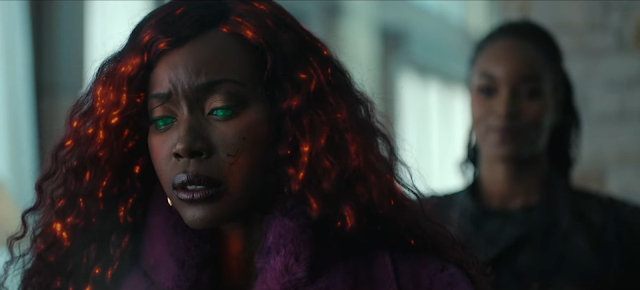
I kinda-sorta had that experience with one of the first shows I ever wrote about on the blog, Titans, although re-reading that post now I find, although I was dumbfounded by the extremity of the violence and lack of moral authority in the show, I was also much more positive about it than I remembered, summing my feelings up with the equivocal

"If all of this sounds like I hate the show then... I don't. I might even love it. I'm not sure. Like every single character in the goddam show, I'm conflicted."

At that time of writing I was just coming to the end of the second season and I was less than certain how many more there were likely be. Season Three had been commissioned but put on hold by the pandemic. I wouldn't have bet then on it ever coming out, much less on there being any Season Four.

The pandemic passed. Season Three got made. I reviewed it here. Once again, I was in conflict with myself over whether or how much I liked it:

"It shouldn't work and it doesn't but I'd be lying if I said I didn't enjoy myself...At least I got to the end of it and didn't wish I hadn't bothered so I guess it worked."

And now we come to Season Four which, as it transpires, is the last. For once, news of the cancellation came in good time for the writers to craft an ending, so there's that, at least.

I would have happily watched more but as I said in the first post, as I passed from my examination of the extreme violence to address the less-disturbing but arguably more pressing question of who might possibly want to watch such a self-referential exhumation of obscure and long-forgotten characters, there was only one possible answer:

"Lifelong DC fans. It surely can't be meant to interest anyone else."


The fourth and final Season does absolutely nothing to counter that assertion. The main villain turns out to be Brother Blood, the name of any number of iterations of a long-time nemesis, surely known only to those deeply enmeshed not just in the DC Universe as a whole but quite specifically in that small portion that contains The Teen Titans in their various incarnations.

As if challenging themselves to "beat that", another significant character eventually reveals himself to be... Freedom Beast, the black African inheritor of the power originally allocated to the now somewhat uncomfortably-named sixties creation, B'wana Beast. Not content with bringing Freedom Beast on for a cameo, the Titans storyline drags most of the backstory across from Grant Morrison's run on Animal Man, stitching it not only into Titans continuity but also that of another recently-cancelled DC show, Doom Patrol. As the old catchline used to go "Confused? You will be!"

Except I wasn't, not really. I correctly figured out who Brother Blood was long before anyone mentioned his name and I recognized Freedom Beast's distinctive helmet almost as soon as I saw him put it on, although I did think he was B'wana Beast for a while, having forgotten all about the Grant Morrison re-write. 

(Fun Fact: Grant Morrison himself appears in a brief, non-speaking cameo in one episode. I thought for one bizarre moment it was Professor Xavier from Marvel's X-Men in some unlikely cross-company promotion. I haven't seen Morrison since I walked out of a cult-leaderish performance he gave at a London Comicon back in the nineties. I'd forgotten he had a completely shaved head.)

There is a lot of this stuff in Titans. There's a lot of it in every DC TV show. The reason beyond any other why I always enjoy watching them, even when they're bad and make no sense, is that above and beyond anything, these are true superhero comic-book shows. 

It's not just the endless trips to the well of forgotten continuity, it's the instant solutions to insoluble problems, the science that's absolutely indistinguishable from magic (Of which there's also plenty in Titans, not least from the effervescent Jinx, who absolutely is not dead, you can take that to the bank....) and the utter disregard for coherent, rational human behavior. The combination of this level of unreality with decently convincing television acting creates a glorious, druglike haze from which I emerge both stupified and satisfied. 

I would watch stuff like this all the time if I could get it but far from being surprised these shows keep being cancelled I'm much more astonished they keep getting made. There clearly aren't enough of the specific fans required to keep them going indefinitely but equally there must be a lot more than I ever thought there were for the shows to exist at all.

Sadly, Clint Mansell seems to have moved on from music duties on the show. This time the soundtrack went mostly unnoticed by me except for Donovan's superb but overused Season of the Witch and the gloriously ironic use of seventies soft-rock classics, playing endlessly through speakers in the streets and homes of the Stepfordesque town of Caul's Folly, where they're used to pacify and mesmerise the inabitants, much as they would have done in real life.

The plot, it won't surprise anyone to hear, I'm sure, makes very little sense. There's also surprisngly little real action. I got the distinct feeling the budget for explosions wasn't what it once might have been, although with a team of superheroes whose main powers consist of being exceptionally physically fit and very good at hitting people with sticks, I suppose you don't really need all that much in the way of special effects.

I did wonder where the show sits in wider DC continuity. There's a big changing of the guard going on at Warners right now, what with James Gunn coming in and all, but (Big Spoiler Incoming...) killing Lex Luthor in Episode One seemed like something that might have wider repercussions. 

Then again, the Joker is also dead in Titans continuity. Batman killed him in Season Three. So I don't know...

Factor in some excellent cameos by Stargirl and most of Doom Patrol, along with a few visual nods to the likes of Shazam and the Flash and it's anyone's guess where any of this stands. Also, anyone's guess who even cares. I mean, you don't, do you?

I guess that's the problem. Once you start making true comic book television only true comic book fans are going to want to stick with it. I think one of the reasons the MCU has managed to make itself so widely accepted is that it's really more of an offshoot of the buddy movie sub-genre than anything to do with the actual comic books.

Titans isn't that. It's a superhero show for people who take comic-book superheroes at face value. It doesn't deconstruct the form or question it. It revels in it. Which is fine by me but also why Season Four ends with most of the characters walking away from the team, telling us what they're going to do next, in the fashion of a coming-of-age movie's post-credit sequence.

Curiously, although there are no cliffhangers, no dangling plotlines and no brooding, ominous hints of troubles to come, the whole thing still manages to feel somehow like a set-up, either for possible new storylines or spin-off series featuring members of the team. It's probably wishful thinking on my part  but Rachel going to college, Gar into The Red, Tim back to Gotham and Dick and Kory walking into the sunset together, taking the Titans name with them, all seems like a new beginning as much as it does an ending.

After the abrupt, unsatisfying finishes of so many other shows I've had to suffer of late, this feels like a win. It may be sad to see them all go their separate ways but at least they - and we - got to say goodbye. 

Only, of course, like death, goodbye is never the end in comic books. They'll be back. They'll all be back. It's just a question of when.
Sunday, January 9, 2022

Redemption Songs


Telwyn
at GamingSF posted recently to say how tired he is of grimdark storytelling in contemporary Science Fiction and Fantasy. It's a trend I've complained about myself, although in my case what I object to most is the interpolation of what would once have been specifically horror genre tropes, themes and settings into just about every other genre ever invented.

As I said in a comment on Telwyn's post, it's particularly the use of violence as an unquestionably acceptable solution to pretty much every problem that irritates me. Even then I'm generally fine with it so long as I'm convinced by the context. In practice, so long as something is well-written and doesn't contradict what I already know about the IP or characters, I'm fine with things getting as grim or dark as they need to make the story work.

Where I have more of a problem is when an amoral, violent or just plain brutal filter gets fitted over IPs that previously felt a lot lighter, brighter or sprightlier. And even then it can work. It just has to be done with thought, care and imagination.

One property I've written about before, where the bootlegger turn from source to revamp gave me whiplash, was the DC superhero show, Titans. I went into the reasons for that and the history behind my concerns in some detail last time so I won't rehash it all again here. 

What I will say is that I recently finished watching the third season of the show and some of the problems and issues I had with the first two have been addressed. It's still a dark and disturbing show but the number of occasions on which any of the Titans are seen acting with the kind of casual, thoughtless brutality that characterized the previous seasons are much fewer and farther between. 

There are still several scenes where one or other of the heroes chooses to deal with a situation by killing someone but in each case it forms a plot or character point that has some meaning or relevance. There are also numerous occasions when members of the team disagree on whether such actions are appropriate, acceptable or effective. 

Differences of opinion on what a "hero" can do and still be thought of as a "hero" form a major part of the series arc, which focuses strongly on transgression and redemption. It's a big improvement but although I would say the show as a whole feels less brutal, I definitely wouldn't say it's any less violent and certainly not any easier to watch. If anything it's worse.

The brutality, which was the most shocking element of the show for me, has been replaced by an element of sadism, which wasn't particularly present before. I find that even harder to watch than the brutalism but I wouldn't dispute that, contextually, it makes sense. It's not something I personally want to see but sadistic violence is inarguably an intrinsic part of the established characters who employ it. If you're going to bring in the Batman's rogues gallery, twisted psyches and extreme violence come as part of the package.

That does beg the question of whether you really need the Joker or the Scarecrow in a Titans story at all. The answer is yes, you do, if you're going to use the entire season to tell a Batman story. And telling a Batman story here does make a kind of sense. 

Titans' leader is Dick Grayson, who is Nighthawk, who was Robin. Jason Todd, who is Robin, is also a Titan, or was. The main story arc of the season revolves around the tripartite relationships between the two of them and the Batman. And it's not a bad story, at that.

The first episode opens with the team established in sunny San Francisco, where the lightness in tone and texture clearly only exists to make the shadows of the rest of the season deeper and darker. By episode two we're in Gotham, which is where we stay. I won't attempt to rehash the plot but it's safe to say everyone has a rough ride and a bad time, not least the audience.

The first five or six episodes are strong, coherent and satisfying. Then everything goes off the rails. Titans die. Supporting characters die. Bystanders die. Hundreds of them. Maybe thousands. Then most of them get better. 

All the arguments about whether heroes or villians should be given the second or third chances, whether sins can be forgiven or redeemed, all the things that looked like they were going to matter or mean something, melt away in the magic rain that makes the dead rise. By the end of the run it's as though the writers are daring each other to see how wide they can stretch a loophole. Wide enough to slip a city through, it seems.

It shouldn't work and it doesn't but I'd be lying if I said I didn't enjoy myself, even if there were scenes where I literally had to look away and others where I literally couldn't believe what I was watching. I'd have preferred a season that stayed as tight and closed as the first few episodes all the way to the end but I have to remind myself it is a show about DC superheroes. Asking for realism isn't necessarily reasonable or rational. 

Asking for believabilty is, though. I guess, within the parameters of the form, Titans Season 3 is believable enough. This is comic-book reality, after all. At least I got to the end of it and didn't wish I hadn't bothered so I guess it worked. I do hope season four, if there is one, happens anywhere but Gotham though, even if Iain Glenn is one of the best Batmans I've seen.

If you're wondering about now why all these really old songs are gumming up the post, it's because all of them are heavily featured in the show. One of the oddest things about the whole season is the music. I don't know who the producers imagine their audience to be but based on the music I can only guess they've been screen-testing the show in retirement homes.

Almost every episode had me open-mouthed at the choices they'd made. Take a look at this list. It's not every song in the whole season but it's most of them and the ones I left out weren't much younger.

  • Ça Plane Pour Moi - Plastic Bertrand
  • Spirit In The Sky - Norman Greenbaum
  • Sloop John B - The Beach Boys
  • Oh Bondage, Up Yours! - X-Ray Spex
  • Bad Life - Public Image Limited
  • In-A-Gadda-Da-Vida - Iron Butterfly
  • Zombie Eaters - Faith No More
  • Ever Fallen In Love (With Someone You Shouldn't've?) - Buzzcocks
  • Le Freak - Chic
  • Don't Let Me Be Misunderstood - Nina Simone
  • Livin' On A Prayer - Bon Jovi
  • In The Mood - Glenn Miller
  • Back To Black - Amy Winehouse
  • Waterfalls - TLC
  • Waterfalls - Death Cab For Cutie
  • New Rose - The Damned
  • Tell Me Something Good - Rufus
  • Just Like Heaven - The Cure
  • What A Wonderful World - Joey Ramone

It's a list that suggests it must have been put together by someone of both a certain sensibility and a certain age. I was very confused until I spotted the name of Clint Mansell in the credits. Mansell, now a respected composer of film music, was the prime mover in eighties' sample-happy satirists Pop Will Eat Itself, providers of yesterday's post title. I saw them live once. I don't remember much about it.


Clint is about five years younger than me. It explains a lot, although  not so much about what any of these songs have to do with the scenes they're in. I'm not complaining, though. It was nice to hear some of them again. 

It's a bit of a theme with superhero shows and movies, anyway, this rifling through the jukebox of the past. That's another wish I have for Season Four: some songs that are less than forty years old. If they're ones I haven't heard before that would be even better.

Monday, September 7, 2020

Stargirl Interlude

By the time I'd watched three seasons of the brutal, nihilistic Titans, followed immediately by two seasons of the occasionally sadistic if mostly playful Umbrella Academy, I was more than ready for something lighter, fluffier and, above all, more unironically and unequivocally heroic. There were several more superhero shows waiting in my Netflix watchlist - Defenders, Jessica Jones, Luke Cage - but before I could take a look to see if any of them might fit the bill I got an alert from my alternate streaming service, Amazon Prime.

I've found the prompts from both Prime and Netflix reliably useful so far. Their algorithms seem to be working well for me. This one felt exceptionally well-judged. It came at exactly the right moment, it featured a character whose guest appearances in another show I'd very much enjoyed and best of all I had absolutely no idea the show even existed.

The show in question is Stargirl, which is, I believe, the latest to roll off the DC Universe production line. As a lifelong DC fan I was very slow to pick up on the bleedthrough from comics to small screen. I'm still very much playing catch-up. Now I'm back in the fold, though, I do try to keep up with what's happening and I would have been quite annoyed with myself for missing this one.


Luckily, I didn't. I might not have known anyone was making a Stargirl tv show but thanks to the Prime prompt I still managed to watch the first season at the earleist opportunity. Earliest in the U.K. at least. We get everything good late.

So, was it any good? And did it manage to wash away some of the bitter aftertaste left by the self-serving cynicism of the aforementioned shows?

Well... yes and no. To both questions.

Whether you're likely to think Stargirl is any good or not depends on your tolerance for typical teen angst as served up by any number of previous CW dramas. That's somewhat misleading, since the CW didn't make Stargirl. DC Universe did. Only DC Universe is no more and Stargirl, whose second season has been commissioned, has gone not to HBO Max but to the CW. Which, honestly, does feel like its natural home.


Even with my extremely high tolerance for high school drama, I was hoping the show would keep the school stuff in the background. It does, although whether it will when the production moves across is another matter. But that's a problem for another day, another Season.

The other thing you'll probably need to have if you're going to enjoy Stargirl is an extremely robust suspension of disbelief. Even by the standards of superhero comics there's one heck of a lot of handwaving required if you're going to get past some of the extremely unlikely choices and decisions made by various characters at pretty much every turn.

I inevitably end up comparing almost every ensemble show with a supernormal teenage cast to the lodestone, Buffy. That's patently unfair but it's often revealing. Take a single, pertinent event that occurs in both shows: the discovery by the title character's mother that she has a daughter who spends her evenings climbing out of her bedroom window to do battle with the superpowerful entities who infest the supposedly sleepy small town in which they live.


How long did it take Joyce Summers to come to terms with the knowledge that Buffy was a Slayer? Did she ever, really? It was a long, slow, traumatic process for both of them, one which I sometimes found difficult to watch. Stargirl's mother, Barbara, adjusts to the news within twenty-four hours, mostly by dint of a bit of googling.

Almost every character seems to have a moment like that. Some have several. And even if you're coping well with their apparent emotional flexibility you still need to deal with their astonishing technological prowess. Stargirl's step-dad, Starman's sidekick Stripesy in a former life, somehow manages to construct - out of old car parts, no less -  a "robot" that acts as as a cross between a Transformer and one of Iron Man's suits.

There's a lot of this kind of stuff. I loved it. It was exactly what I was looking for. It could almost have come from the DC comics I grew up with. It has that silly sixties sparkle. Or maybe fifties, because the nineteen-fifties are something of a trope in Stargirl's aesthetics and soundscape, largely via Pat, who gives the impression of having been around back then even though he looks about thirty-eight.


So, all good then? All the blood-smeared scar tissue left by Titans and the Umbrella Academy nicely wiped clean with good, wholesome superheroics? Yeah, not really.

Stargirl herself, along with her once-again sidekicked step-father, now re-branded as S.T.R.I.P.E. are unambiguously honorable, heroic characters. Proper, old-school, duty-driven superheroes. The rest of the teen Justice Society of America, recruited by Stargirl in mid-season, all have significant, well-telegraphed "flaws" (obsessive and self-centered, angry all the time, bitter and betrayed) but they all do a pretty good job of rising above them.

Until one crucial moment in the season finale, that is. When one of them kills someone.

I won't say who kills who because spoilers but it's a genuinely a shocking moment. Not in the stlye of Titans or the Umbrella Academy, where the shock comes from how vicious or violent or psychopathic the supposed heroes are being, but because of how unexpected it is.

And that's good. But it's still a teenage superhero killing someone in a supposedly fluffy show. The rules have changed, after all.


It's tempting to make excuses. After all, while the good guys are, by and large, genuinely good here, the bad guys are really, really bad. Sadistic, brutal, terrifying. There are a lot of them and all of them are completely horrible. I'd struggle to say which one I detested the most.

Which is probably how it should be. Once again, standards have changed. In the sixties the villains would have been buffoons or caricatures. The Injustice Society seem more suited to the eighties and nineties, when sociopaths were very much in vogue.

It's an odd dichotomy, the fifties/sixties heroes up against the eighties/nineties villains. It works, but not comfortably. And heroes still shouldn't kill. Not those heroes.

If what you're after is fundementally decent heroes and existentially evil villains butting heads under comic-book rules, then Stargirl serves it up consistently, even if the premise itself feels far from consistent. It helps that the action is well choreographed, the writing solid and the acting better than decent.


Brec Bassinger as Courtney "Stargirl" Whitmore is close to perfect in the lead and there are some stand-out supporting performances, particularly Luke Wilson as Pat, Stargirl's long-suffering stepdad and Meg De Lacey as Cindy Berman, our hero's ineffably entitled nemesis. Trae Romano, Courtney's "little brother" Mike, steals just about every scene he's in. I could live without the bulldog but at least he doesn't get any lines.

I thoroughly enjoyed every episode and the two-part season finale is one of the better series climaxes I've seen. Except for the slightly bathetic "after the crisis" Christmas cooldown, that is. I'd have left that out.

Of course, as Wilhelm was bemoaning, now we have to wait. That's the problem with watching things when they're new. Plus there's the added frisson of the change of ownership. As I found recently with Lucifer, that can be a bit of a wildcard. I don't find Geoff Johns' promise that Season 2 will be "different" terribly reassuring, either.

Then again, by the time I get to watch it, maybe I won't remember what Season One was like, anyway.


Monday, August 24, 2020

Imaginary Friends

Wilhelm posted on shows he's been watching, these long indoor nights. I could do with a quick and easy idea for a post of my own right now, plus I was looking for an excuse to work my recent Netflix subscription into the conversation, so I'm going to pretend this is a response.

As I think I mentioned, I wanted to watch the fourth season of Lucifer. For arcane (maybe hellish) reasons it's on Netflix in the U.K. rather than Amazon Prime like the first three. I asked Mrs. Bhagpuss about the possibility of my piggybacking on her own piggybacked, daughter-hosted access.

It seemed to be quasi-legal. maybe. I read the Terms of Service but I couldn't make a whole lot of sense of them. There's a a lot of talk about devices but not much about people or accounts. It turned out to be a moot point anyway. Apparently shared access hadn't been working for a while.

We could have looked into that but at this point we both had a simultaneous epiphany. Why not get our own Netflix account? Radical! Sharing that, which would definitely be within the ToS, would cost us less than a fiver a month, each. That's practiacally free!

Why it took us a couple of years to come to this earth-shattering conclusion beats me. Sometimes you see the weave not the pattern, I guess.

So, we got Netflix. Since then Mrs. Bhagpuss has watched around a gajillion episodes of RuPaul's Drag Race, starting from the beginning and working forward. I haven't watched any but I know a surprising amount about it, now, all the same. Hard not to in this house.

I started watching the fourth season of Lucifer but to my own great surprise I quickly found I didn't want to, any more. There were some very obvious changes in the opening couple of episodes that felt  new-network-inspired and while they didn't make things that much different, they made things different enough to throw me off.

Had Lucifer still been on Prime, I'd have stuck with it and I will go back in a while, when I've forgotten enough about how it used to be to be fine with how it is, but the lure of so many fresh-to-me shows on Netflix was too tempting to resist. I dropped the devil for the deep blue sea of possibilites, the first of which, as I've discussed in some detail already, was Titans.

Titans was a rough watch and really not ideal for the last thing I'd see each night before I dreamed. I needed something to take the edge off before I went to sleep. Looking through the myriad possibilites I spotted something I'd wanted to see for years: Bojack Horseman.

Until now, everything I knew about Bojack Horseman came from Wilhelm's blog. That was where I first heard of it and pretty much the only place I ever did. He made it sound so intriguing I put in the effort, years ago, and tried to watch some episodes on YouTube, where everything is up at least until it gets taken down.

I didn't have much luck. All I found were a few clips but they served to whet my appetite further. When I looked into it, though, there seemed to be nowhere to watch the show other than Netflix. There were a few DVDs but they were imports, expensive and incomplete. Reluctantly I put the idea aside. Until now.

I've seen about half the first season. Let me tell you, it's no Mr. Ed. Yeah, I imagine everyone made that joke when it started. Anyone who didn't surely has more self-control than I do.

As I mentioned in that Titans piece, Bojack is rated 18, for absolutely no reason I can fathom. Yes, it's a little bit sweary and there's some sex, but by the standards of just about everything else I've watched in the last five years it's positively genteel.

I love it, so far. It's smart and funny but the real strength is in the characters, many of whom are painfully well-drawn despite not being very well drawn at all. It's also bleak as hell. If these are the early, funny seasons I have to wonder what I'm letting myself in for.

It became apparent pretty quickly that I couldn't rely on Bojack as a mood sweetener after Titans. Looking at the options, if I was looking for something as warm and cosy and familiar as an old sweater, what better choice than than Friends?

Yes, of course I've seen Friends. Like every human being alive in the '90s I watched every episode, some more than once, since it the damn show seemed be on permanent rotation on broadcast t.v. back then. The nineties were a long time ago, though. It must be more than twenty years since I last heard Chandler mis-emphasize a word. Long enough for the memory to feel nostalgic rather than nauseating.

I love sitcoms. Discovering MMORPGs gave me a fifteen year break from watching or even thinking about them but when that glamor began to wear off about the first thing I did was go on something of sitcom binge. Most of the shows I'd liked first time around seemed to have held up well so why not the ubercom? And anyway, to resist would be like avoiding World of Warcraft just because everyone plays it. I like to think I've learned my lesson there.

You'll be glad to hear I'm sure as hell not going to start reviewing Friends in 2020. Suffice it to say I'm onto Season 2 and the most surprising thing about the show so far is how much I remember and in how much detail. Oh, and how many sex jokes there are. Seriously, it's a lot.

When I re-watched all eleven seasons of Frasier a few years back it turned out I remembered nothing past about Season 3, which was hardly surprising because it also turned out I'd never seen anything past Season 3, even though I'd have sworn in a court of law I'd watched the entire series end to end. I think I can already remember entire plotlines in Friends going forward years from where I'm at now but I'm prepared to find out I'm wrong there, too.

One thing's for sure. In both cases I remember the characters intimately. As if they were people I've met. As if they were people I know.

I'm not saying that's a good thing. As I get older it becomes more and more apparent to me that what makes serial fiction so powerful is the way it  manipulates biology. Our brains haven't evolved sufficiently yet to differentiate the images and voices coming from the screen from those of real people in the room with us. When those images and sounds express an emotion it triggers a chemical reaction and we emote too. Sociopaths excluded, naturally.

The emotion we feel feels no different from a real emotion. That's because it is a real emotion. All emotions are real. It's chemistry, not metaphysics.

My current theory is that that's why I'm repeatedly drawn to ensemble pieces with recurring characters, imaginary people I imagine I like. My stupid brain thinks they're my friends.

With Titans that didn't really happen, probably because I couldn't stand half of them and those were the nice ones. None of them felt like people I'd want to hang with. They were more like family than friends and I've never been much of a family guy.

I guess I'd hang with Bojack and Diane and Princess Carolyn. Maybe even Mr. Peanutbutter. It's a little difficult to be sure. The brain gets a little fuddled with all the cross-species cartooning. I doubt there's evolutionary biology for that. I definitely feel something but it's not like Roswell or Smallville or Buffy or any of the other shows that effortlessly convince me I'm somehow part of a gang. Not a "gang" gang, you understand. Just a gang of friends.

Mrs. Bhagpuss hates to get to the end of novels she likes because what felt good feels bad when it stops. I don't have that problem with books but I do with series t.v.

It never really was an issue when I watched a show half an hour, once a week for a few months. Then a year off, start again. That's how we did it, last century. It sure is a problem now, though. These days I need a cooldown at the end of the final season of anything I really like. I have to read online reviews of the show I've just finished for a few hours to ease me out of the relationship before picking up with something new. Someone new.

Not everything works that way. Sometimes the triggers don't fit the receptors. Titans wasn't snug but I still enjoyed it, even when I hated it (that last episode sucks!), which is an intellectual response rather than an emotional one, I think. When it ended it left a supernatural/paranormal/superhero ensemble-show-sized  hole in my schedule. I filled it with The Umbrella Academy which, bizarrely, put me briefly in tune with the zeitgeist.

Netflix is very keen to tell me how popular that show is. #3 in the United Kingdom last week, apparently. Fell to #4 yesterday. Already I'm going out of fashion.

I could claim to be an early adopter. A while back, quite a while, it feels like at least a year, someone in the blogosphere mentioned the Umbrella Academy. I'm very sorry to say I don't remember who it was, but they were sufficiently convincing in their advocacy that I watched the first couple of episodes, back when we had the borrowed feed.

I had to watch it on Mrs. Bhagpuss's computer when she wasn't using it, which is basically only when she's at work. It wasn't ideal. I'm not generally much for watching shows or movies in the daytime anyway and it made things all a bit too "appointment to view" for my tastes. I was impressed but it was too much trouble. I dropped out after the first couple goes.

Well, now I'm back. Tonight I'll watch the last episode of the first season. It's an excellent show if you like shows that know they're excellent. I highly recommend it. It has convincing, peculiar characters, well-acted. It has a sharp script, some good jokes, exciting action scenes and a compelling plot. I really like it a lot.

And yet, despite the quality and the classic ensemble set up - literally a family of unrelated individuals, the trope could not be more meta - it doesn't do that thing I was talking about. I'm never inside their world. I never feel I'm one of them, there with them, sharing their feelings, their experiences, their lives.

Which isn't all that surprising because the Umbrella Academy is stagey as hell. It's camp and startling and clever and knows it. And because of it, my emotions are buffered. I feel things but at a remove. Which is great. It means I can relax and enjoy it even when bad things happen to people I like, which they do, frequently.

It's strange how these things work out. Noel Coward pointed out the potency of cheap music although I never felt he meant what I would have meant by it. What I do know is that not everything needs to be deep. It's all too easy to drown in shallow water, after all.

I've always trusted my feelings when it comes to art. I believe that makes me a philistine or a barbarian, something along those lines. Maybe an aesthete or a hedonist. An epicure?

I guess if I was more of an academic I'd know what to call myself. But then, what would I call my imaginary friends?

Sunday, August 16, 2020

Ultraviolence

When Mrs. Bhagpuss and I finally caved and signed up for our own Netflix account earlier this month, one of the first series I added to my list was Titans. I've always been something of a fan of DC's junior Justice League, going back almost to the day it began.

I still have my copy of the team's first headline outing in their own title, Teen Titans #1. It came out at the very start of 1966. I probably got hold of it a few months later. I can't remember exactly what I thought of it when I was seven or eight years old but it has the distinction of being the only comic where I burned away the faces of all the characters on the cover with a magnifying glass, so maybe that tells us something.

Whatever my feelings, it didn't stop me going on to buy every other copy of the original run I could get my childish hands on, which wasn't all that many. Comics distribution in the United Kingdom was infamously random in the 1960s and '70s, a much written-about topic I don't intend to re-hash here.

I'd always liked the artwork in the Teen Titans comics. It was lush and illustrative rather than brittle and cartoonish. When I advanced into comics fandom proper in my late teens I began to pay attention to the names of artists and writers and I learned that was down to Nick Cardy.

At this point I could easily get sidelined onto a discussion of Cardy's talents and the changes in house style that made DC Comics of the period feel so jarringly inconsistent. But that's not what I'm here to talk about. Let's just stick to The Titans.

Remember when smoking was cool?
Like almost all superhero series, the Teen Titans underwent endless revisions and relaunches. Perhaps the most radical came at the very start of the 1980s, when Marv Wolfman and George Perez re-branded the title as the New Teen Titans and turned it into one of the most successful superhero comics of its era.

I interviewed Wolfman at the peak of the title's success, talking to him for around an hour in a back room at a London comic convention for a piece to be published in a U.K. comics semi-pro 'zine. He was a friendly, approachable interviewee, as well he might have been, given his own origins in comics' fandom.

He may have been tired by then of being quizzed by eager fans on his controversial creation, the psychopathic Terra, who "infiltrates the Titans in order to destroy them" as Wikipedia puts it, but if so he didn't let it show.  He responded with enthusiasm as I quizzed him on the putative personality and motivation of his imaginary bad girl, with whom, to the surprise of absolutely no-one who knew me at the time, I was openly and obviously enthralled.

I recall that the Terra storyline was considered somewhat controversial back then, centering as it did on an amoral, foul-mouthed, nicotine-addicted, murderous sociopath and pathological liar, who also happened to be a member in good standing of a team of adolescent superheroes. By the early eighties comicbook anti-heroes were hardly a fresh phenomenon but Terra's particular style of nervy, sassy badness was particularly hard to hand-wave away, even when set against a cast of morally compromised characters that included Raven, daughter of the evil godling Trigon and Starfire, battle-hardened warrior-princess of an aggressive, alien empire.


Absolutely nothing I dimly remembered about that supposedly morally grey rendition of the Teen Titans could have possibly prepared me for the latest incarnation of the team as delivered by Netflix. And yet, without those memories, would I even be able to make even the slightest sense of any of it? Doubtful.

Two things distinguish Netflix' Titans: an unremitting brutality and an absolute refusal to acknowledge the  existence of an audience outside its given milieu. The former is disturbingly commonplace in contemporary fantastic fiction, the latter, less so. Creators generally have at least a passing interest in widening the circle. Not this time.

I'd be very interested to hear the opinions of anyone who's watched this series without prior knowledge of the characters. Is it even clear who they are? Does anything they do make the slightest sense? Are any of them remotely bearable as personalities? Do they come across as anything more than vicious thugs with a shaky line in self-justification?

It seems to me that the writers began with the assumption that no-one would be watching the show at all unless they were already fans of the I.P. so they didn't feel they needed to waste time explaining anything. And what a lucky break for them that was! The lack of exposition must have left plenty of space to graft in some more gratuitous violence and Titans is a show than can never have enough punches to the head.

If you are acquainted with the group's history, though, this feels rich. I haven't read a Teen Titans comic for maybe a quarter of a century so the resonances are faint but my god they're strong. And frequent. Every episode rings with echoes of my past. Names, situations, relationships, storylines; they all emerge, tangled and distorted, changed, screwed with, torn, ragged and bleeding.

Much like the "heroes" themselves and very much like the helpless, defenceless targets of those heroes' bludgeoning fists. I've watched a lot of superhero shows in the last few years and naturally they all involve people beating up other people but this is taking superhero violence to another level altogether.

There are a few, very disturbing, instances of sadism and torture but mostly it's sheer, unmitigated brutality. People punching other people in the head, again and again. Sometimes breaking an arm or a leg for variety. The occasional stabbing.

One of the lighter moments from Season One: Rachel's father rips her heart out before crushing it in his fist as her friends watch and smile. Seriously, this did count as a lighter moment. It's comic-book violence, at least...
Starfire provides some variety from the punch-punch-punching whenever she burns someone to ash, which, in the first season, at least, is often. Raven occasionally unleashes her cosmic side to throttle a team-mate or slash them with razors. Gar's the pacifist of the bunch, mainly restricting himself to a roar and the ocasional over-the-shoulder body toss. Only once does he savage a man to death, which shows some restraint for a tiger.

Since several of the supposed "super" heroes have no powers at all, beyond extreme physical fitness, and some of them don't even have that, there's not much they can do, other than use their fists. The Robins (there are two of them and that's not confusing, at all...) have the benefit of Batman's exceptional training plus some technological back-up courtesy of Wayne Industries but Hawk is just a college football star and Dove is... a young woman who used to be a ballet dancer? I think. It's a bit vague, to be honest. How that equips her to fight super-villains is anyone's guess.

But that's okay because mostly they don't fight super-villains. They chase down sexual predators, drug dealers and sundry ne-er-do-wells with the intention of delivering vigilante justice with their fists or any old iron bar or broken bottle that falls to hand. They frequently beat to a pulp individuals who very clearly have absolutely no hope of defending themselves, let alone fighting back, the justification sometimes being that those individuals gave no more consideration to their own victims.

That would be morally awkward enough but things frequently move far past scales of grey to something approximating an absolute absence of moral illumination of any kind. There are multiple scenes across many episodes where one or other of the team cripples or kills someone - often many someones - who merely happened to find themselves in the way.

There's one astonishing scene where the younger Robin, Jason Todd, viciously attacks and injures half a dozen police officers, not merely because they arrive to investigate the sounds of battle in some fight he's having, which would be bad enough, but because he hates policemen and he judges he can get away with it. And says so. The other Robin, Dick Grayson, isn't happy about it but he doesn't do anything to stop it.

There are dozens of scenes like that across the two seasons although the second season features more beating up actual costumed villains and less crunching fists into the faces of uniformed law-enforcement professionals. It makes the supposed moral dilemmas that bring anguished expressions to the characters' faces as they wrestle with what we are expected to imagine must be what passes for their conscience embarassingly into focus.

At least when Kory uses her powers you can see what's going on. This show is dark in more ways than one.
An extended sub-plot concerns Dick Grayson's anxiety over whether his mentor, Batman, might be on the verge of going "too far", by which Dick means killing someone, most likely The Joker. Unfortunately, the entire thing is rendered ironically risible by the simple fact that every one of the Titans, without exception, has killed at least one person, on screen, in front of us, already. Some angst about it afterwards and some openly enjoy it but they all do it, regardless.

At first I found the level of violence utterly astonishing but after a while I just kind of got used to it. It would be nice to think the writers' were making some kind of point about habituation. The characters do occasionally allude to it so maybe they are. It feels more like a demonstration than a deconstruction, though.

The certification is confounding, too. I realize that things that would have required dozens of cuts to gain an 18 certificate not all that long ago now routinely feature in GCSE syllabuses but even so. Titans is a 15 certificate but Bojack Horseman, which I started watching at the same time, is rated 18. Bojack, so far, has fewer drug references, milder sex scenes and less swearing than Titans. And no violence at all. Plus it's a cartoon so it's already distanced. Who rates these things and how?

Moving away from the violence, there's the less controversial but more confusing question of who this show is made for. I can answer that one: lifelong DC fans. It surely can't be meant to interest anyone else.

The sheer number of callbacks to information that exists only outside the world of the show is astounding. When Donna Troy, Wonder Girl, appears I don't think there's a single moment when it's explained who she is, why she has the name she has (which she no longer uses, anyway), who the all-female organization who tell her what she can and can't do are and what authority they have over her. The name "Themyscira" is thrown around as though it might be "Paris" or "Florida" but if Wonder Woman ever gets a mention I missed it.

Rachel: Just let me finish my coffee and then I'll get right on with killing you.
Rose: I'd like to see you try. But you're gonna have to move outta my blind spot first.

The entire first season is really an extended origin story for the team. The second season, too, really. The heroes themselves, though, get the most cursory of backstories. We're assumed to know all about Batman and Robin, which may be fair enough. Raven and Starfire come into focus slowly as they learn about their own pasts. Hawk and Dove are allowed a great deal of screen time to reveal their history but almost none of it makes any sense.

Beast Boy, or Changeling, neither of which anyone ever calls him - Hank calls him "Tiger Boy" once, as a joke - gets the equivalent of a one-line introduction. The writers seem to have no idea what to do with him, anyway. He mostly just turns into a tiger and roars then re-appears as a naked teenager, clutching the nearest plant-pot to hide his embarassment. Once he turned into a snake, so someone in the writers' room apparently at least remembers what his powers are supposed to be, but that happened after Hank had beaten him to death and never again, so who knows what was going on.

As for Rose, she's been in the show for most of Season Two (I'm about three or four episodes from the end) and literally all we know about her is that she's "Deathstroke's daughter". It might as well be her codename. Her powers seem to consist of some martial arts and an eye-patch. Oh, and Raven killed her once and then she got better so there's that. It's a bit of a rite of passage in Titans, killing one of your team-mates. Fortunately for recruitment, such deaths are rarely fatal.

If all of this sounds like I hate the show then... I don't. I might even love it. I'm not sure. Like every single character in the goddam show, I'm conflicted.

What I do know is that Titans was made quite specifically for me. I get almost all of the references, even the ones that refer to comics I never read. I know all these people as well as, better than, people I actually know. I've been with them almost all my life, after all.

As for the violence and the amorality, well, I'm the one who took Marv Wolfman to task for killing Terra off. She was my favorite character. I wanted her to get her own title or at least stay in the Teen Titans for ever.

Four out of seven's not bad.
Terra had the moral standards of a rabid, narcissistic rattlesnake. It's karma, isn't it? You want anti-heroes? Here, have them. See how you like it. And next time, be careful what you wish for.

The real danger isn't the bleak arithmetic of the hero business, though, or the exponential overload of negative karma. It's the realpolitik of megacorps business practices in the outside world. Season Three was commissioned and in production when the pandemic hit and put everything on hold. Since then there's been an even bigger existential threat to the future of this and every other DC show.

Parent company Warner Bros. decided to rationalize their streaming content under one brand, HBO Max. They canned DC's nascent in-house service, DC Universe, Titans' home channel. How that will affect the future of the show remains to be seen but it's hard to imagine it will be anything good.

The picture here in the U.K. is more complicated still. We never even got DC Universe. It was rumored to be coming to the U.K. around Easter but that never happened. There seem to be no plans, currently, to bring HBO Max here, either.

At time of writing almost every show I care about that's currently airing on HBO Max in the U.S. is on Netflix here in the U.K. That suits me just fine. Let's hope it stays that way.

Even if it doesn't, even if I end up having to wait til it comes out on DVD, one way or another, I'm in for the long haul with Titans. I'm not saying I like them. Far from it. I loathe Jason Todd, I despise Hank, I don't like Dawn much at all, although she's so rabidly inconsistent it's hard to know who she even is half the time.

Rachel is annoyingly emo. Gar is wishy-washy, also whiny and bland. Dick is arrogant, stubborn and frequently irrational. Kory and Donna, I guess I do like, at least some of the time. Even Rose has her moments.

What the heck, though. I've known most of them since I was at school. We grew up together. I don't need to like them. I just need them to be there.

If I can't have the Legion, the Titans will do in a pinch.
Wider Two Column Modification courtesy of The Blogger Guide